Local Insights


Savannah, Georgia's historic squares, cobblestone streets, and river views make it one of the most visited small cities in the country, and that popularity has turned short-term renting into a real option for homeowners across the city. But Savannah's rules go deeper than most cities' size. They actually run two separate systems depending on what you're renting: renting out an entire property works differently than renting out a spare room. Getting the wrong one can be an expensive mistake. Here's what actually matters if you're thinking about listing a property.
Georgia has no statewide short-term rental law. There's no license you get from the state, no state-level cap, nothing. A 2019 bill (HB 523) would have stopped cities and counties from banning, capping, or licensing short-term rentals in the first place, but it never passed. So that authority stayed exactly where it already was: with each individual city and county, which is why Savannah's rules look nothing like Atlanta's, or Pooler's, or even unincorporated Chatham County right next door. Here's what homeowners need to know before renting out a property for 30 days or less.
Yes, but Savannah actually runs two separate systems depending on what you're renting, and they don't follow the same map. Renting out an entire property is one thing; renting out a single room in a home where you still live is a completely different category with its own zoning rules.
Savannah defines a short-term vacation rental, or STVR, as an entire dwelling unit rented to guests for 30 consecutive days or less. This is what most of this guide covers.
Whole-home short-term rentals are limited to the STVR Overlay District, which covers the Downtown, Victorian, and Streetcar (formerly Mid-City) local historic districts. Outside that overlay, whole-unit vacation rentals are only permitted in certain Business and Agriculture zoning classifications (B-C, B-N, B-L, and A-1). If you're outside the overlay district and outside those specific zones, renting out an entire property short-term isn't an option under current rules.
Renting a single room in a home where the owner also lives is regulated as a "bed and breakfast homestay," not as an STVR. It falls under a separate part of the zoning code (Sec. 8-3025) with its own list of permitted districts, unrelated to the STVR Overlay District above. On the residential/institutional side, that's RIP, RIP-A, RIP-B, RIP-B-1, RIP-C, I-P, and R-D; on the business/industrial side, it's BC-1, B-G, I-L, and I-H. It's not permitted in Savannah's most common residential zones (R-20, R-10, R-6 and its variants, R-4, R-M, RMH), and being inside the STVR Overlay District doesn't automatically qualify a property for homestay either. The two run on completely different maps, so each has to be checked separately.
By definition, a homestay is capped at one bedroom, rented to no more than two adult transient guests, in an owner-occupied home. If breakfast is served, it's the only meal allowed, and only for registered guests.
.webp)
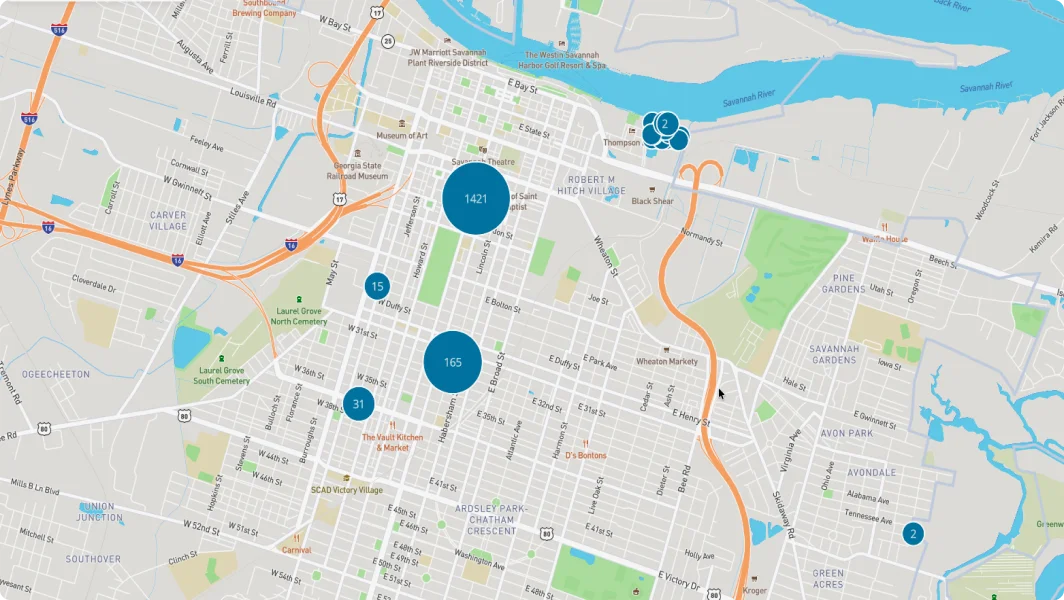
The city publishes an official STVR overlay map showing exactly which parcels fall inside the overlay district, the fastest way to check a specific address. The overlay covers three historic areas, and each works a little differently.
The largest of the three historic areas, and the one most people mean when they picture Savannah's short-term rental market. Non-owner-occupied rentals here are capped at 20% of residential parcels per ward, and every single ward in this district has already reached that cap. There's currently no open capacity anywhere in the district for a new, non-owner-occupied certificate. (See the official ward map for the full list of capped wards and where your specific address falls.)
Runs under the identical 20% per-ward cap as Downtown and is in the same position: every ward here has also hit its limit, with no open capacity for new non-owner-occupied certificates.
Not subject to the ward cap at all, but it has its own separate restriction instead, covered in the Streetcar section below.
Outside all three historic areas, the only other places a whole-home vacation rental can legally operate are properties zoned B-C, B-N, B-L, or A-1, Savannah's Business and Agriculture classifications. A residential property in an ordinary neighborhood outside the overlay, no matter how nice or how close to downtown, isn't eligible for a short-term rental certificate under current zoning.
Unless a property already has a grandfathered or existing certificate, sits in the Streetcar district and meets its multi-unit rule, is owner-occupied, or is zoned B-C/B-N/B-L/A-1, a new non-owner-occupied application in Savannah's historic core goes straight to the waiting list. The city maintains that list on a first-come, first-served basis through the STVR Waiting List Form. The city itself doesn't publish an estimated wait time, so there's no official number to point to.
Informal reports from local real estate agents and investors who've actually gone through the process paint a rough picture: some describe waits stretching multiple years, and there have been stretches where agents reported that essentially no new non-owner-occupied certificates were being issued in capped wards at all. None of that is an official city figure, and it can shift as certificates get revoked or lapse. The honest takeaway is the same either way: if a certificate opening is central to your plans for a property, treat the waitlist as a long shot you might wait years for, not a queue you can plan a timeline around.
The city's STR Public Portal lets anyone look up whether a specific property already has an active certificate and shows the program's overall scale: as of this writing, 1,676 licensed short-term rental properties are citywide.
One detail that trips people up: short-term rental certificates in Savannah are non-transferable. If you buy a property with an active certificate, that certificate doesn't automatically come with the sale.
There's a narrow exception. The ordinance uses "transferee/grantee," not "buyer," which means the exception covers a sale, an inheritance, a gift, or a divorce settlement alike. The transferee/grantee has six months from the date of transfer to apply for their own certificate without being denied for exceeding the ward cap. Outside that window, they're treated as a new applicant, subject to the current cap and waiting list.
For an inherited property, the city doesn't specify whether that six-month clock starts at death, at probate close, or at deed recording, so confirm the exact date with the city directly rather than assume.
Certificates issued before September 28, 2017 are grandfathered in and can still be renewed even in wards that have since hit the cap.
In the Streetcar (Mid-City) local historic district, properties zoned TN-2 have an additional requirement: the parcel must have two or more dwelling units, and at least one of those units must be owner-occupied. A single-unit home in this district generally won't qualify for a standalone certificate.
Savannah caps how many guests can stay in a vacation rental based on bedroom count:
Bedrooms are subject to verification for building code compliance, so a room advertised as a bedroom needs to actually meet the code definition of one.
A few operational standards come up often enough in real Savannah listings and city guidance that they're worth calling out separately, even though they're smaller than the zoning and cap rules above:
These operational rules trace back to the city's own STVR Administrative Enhancements policy, tied to the exemplar rental agreement every certificate holder has to post, not something an individual host made up. These are the kind of details worth spelling out clearly for guests before they ever check in, and writing house rules that actually protect your property is worth doing well, not just as a compliance checkbox.
The application runs through the city's STVR registration portal. Here's the process step by step.
Before applying, have these ready:
The short-term rental license cost is non-refundable either way:
Once the STVR application is approved, owners also need a Business Tax Certificate from the city's Revenue Department before the certificate is finalized.
The certificate number needs to appear in every listing and advertisement, on every platform where the property is marketed. Inside the unit itself, a legible copy of the certificate must be posted showing the rental agent's name, address, phone, and email, the Business Tax Certificate number, the maximum occupancy, and the maximum number of vehicles allowed to park at the property.
If the rental agent on file ever changes, it's the property owner's responsibility to notify the city within five business days through the STVR Registration Portal's Rental Agent Change Form.

Three charges apply, and they stack on top of each other, not instead of one another:
The $5 nightly fee is a statewide charge that applies to accommodations booked through a marketplace platform (Airbnb, Vrbo, and similar), which covers the overwhelming majority of Savannah short-term rental bookings. Platforms that qualify as "marketplace innkeepers" under Georgia law generally collect and remit this fee automatically alongside the other taxes, the same way they handle the percentage-based taxes.
All of these are due to their respective agencies by the 20th of the month following the rental. Hosts who take direct bookings outside a platform are generally responsible for registering and filing all three themselves.
As of July 1, 2026, Georgia's new Human Trafficking Prevention Training Act (SB 570, codified at O.C.G.A. 43-21-16) requires hotels, inns, and short-term rental operators statewide to provide annual human trafficking awareness training to covered staff. New hires have 60 days from their start date to complete it.
This mostly targets operations with actual employees, not solo hosts. The law exempts short-term rentals that are managed directly by the individual owner with no staff, and rentals booked for fewer than 15 days per year. Many Savannah homeowners renting out a single property themselves will likely fall under one of these exemptions, but anyone running multiple properties or employing cleaning or management staff should check whether the exemption actually applies before assuming it does. Violations carry fines starting at $500 for a first offense.
Savannah takes short-term rental compliance seriously enough to run a dedicated complaint portal and a 24/7 hotline (912-226-0320) for reporting issues at vacation rental properties. Anyone, not just neighbors, can file a complaint anonymously by category (noise, trash, parking, illegal rental, guest count, or other), and the form specifically tracks whether it's a repeat complaint against the same property, which feeds directly into the violation count below.
Per Section 8-10017 of the city's own Short-Term Vacation Rental ordinance, violations carry fixed fines that can't be waived or reduced:
If a property accumulates three violations within 12 consecutive months, the city revokes any pending certificates for that property and rejects all new applications for it for a full 12 months.
The rental agent named on a property's application has a real, timed obligation here too: they must appear on-site within two hours of the city notifying them of an issue, such as a noise complaint or disorderly conduct. Failing to respond to two or more complaints can itself be grounds for penalties.
An owner who disagrees with a revocation, suspension, or denial can appeal to the city manager in writing within 30 calendar days. Filing that appeal on time pauses the enforcement action until the city manager rules.
Not every property with a Savannah mailing address is actually inside Savannah's city limits. Some fall within unincorporated Chatham County, which runs its own, separate short-term rental program through the county's Department of Building Safety and Regulatory Services. Before assuming city rules apply, it's worth confirming the exact jurisdiction, since the two programs are genuinely different.
The county's program doesn't have a per-ward cap, but it's not a lighter lift on paperwork. A new license runs $350 per establishment, and the application requires a fairly extensive packet, including:
Occupancy is calculated a little differently than in the city: no more than 2 adults per bedroom plus 2 additional adults. Noise is governed separately under the Chatham County Noise Ordinance rather than the city's code.
Certificates are valid for one year. Renewals run between May 1 and June 30 each year, cost $350, and carry a $175 late fee if missed. The county also makes clear the certificate is not a contract and can be revoked at any time, and that failing to keep the application information current is itself grounds for revocation.
Important as of this writing: On July 10, 2026, Chatham County commissioners approved a 120-day moratorium on new short-term rental applications, effective until 11:59 p.m. on November 7, 2026 (unless shortened or extended). The county is not accepting or processing any new short-term rental licenses, permits, or applications during this window while it rewrites its 2021 ordinance. This does not affect existing certificates or renewals already in process, only new applications. Anyone considering a new unincorporated Chatham County property should confirm current status before assuming the process above is open.
Recent Airbtics data (trailing twelve months through January 2026) puts the median Savannah short-term rental at roughly $51,000 in annual revenue, 65% occupancy, and an average daily rate around $208. Other trackers report somewhat different numbers, occupancy ranging from 46% to 65% and daily rates from $208 to $309, depending on how they define an "active listing." The takeaway is consistent across sources: Savannah supports a genuinely active, revenue-generating market, especially for well-located, well-managed properties in the historic core

Not every nearby market runs on Savannah's rules. Tybee Island, the popular beach town just outside the city, has some of the strictest short-term rental laws in the metro, with new residential permits frozen since 2022 and an ordinance overhaul underway for 2027. Pooler took its own different approach, a 500-foot separation rule instead of a ward cap. Neither affects properties inside Savannah city limits, but both are worth knowing about if you're looking at the wider metro.
Yes, but only within the designated STVR Overlay District (Downtown, Victorian, and Streetcar historic districts) or in specific Business and Agriculture zones elsewhere in the city.
Yes. Every ward in the Downtown and Victorian districts has hit its 20% cap on non-owner-occupied rentals, so new applicants go on a first-come, first-served waiting list. The city publishes no official wait time, but informal reports from local agents describe multi-year waits, so treat it as a long shot rather than something to plan a timeline around.
No, certificates are non-transferable. The ordinance uses "transferee/grantee" rather than "buyer," so this covers a sale, inheritance, gift, or divorce settlement alike: the transferee/grantee has six months after the title transfer to apply for their own certificate without being denied for exceeding the ward cap. For an inheritance, the city doesn't specify whether that clock starts at death, at probate close, or at deed recording, so confirm the exact start date with the city directly.
Fines are fixed by ordinance and can't be waived: $500 for a first violation, $750 for a second within 12 months, and $1,000 for a third. Three violations on one property within 12 months triggers revocation and a 12-month bar on reapplying.
No, not as of this writing. Commissioners approved a 120-day moratorium on new applications on July 10, 2026, running through November 7, 2026, while the county rewrites its ordinance. Existing certificates and renewals aren't affected, and this applies to unincorporated Chatham County only, not the city of Savannah.
It depends. A new state law effective July 1, 2026, requires it for hotels, inns, and short-term rentals with staff, but exempts owners who personally manage their own rental with no employees, as well as properties rented fewer than 15 days a year.
This guide is for informational purposes only and does not constitute legal advice. Short-term rental regulations change frequently. Verify current requirements directly with the City of Savannah, Chatham County, and a qualified Georgia attorney before listing your property.
Savannah's short-term rental rules are detailed, but they're also predictable once you know where to look. Location inside the overlay district, ward cap status, and certificate history are the three things that determine whether a property can operate as a short-term rental at all, well before pricing or marketing even enters the picture. For homeowners who already have a certificate or who are evaluating a property that's owner-occupied, grandfathered, or in the Streetcar or Business/Agriculture zones, the market fundamentals remain strong for owners who manage the compliance details carefully. Triad already handles vacation rental management in Savannah's historic district, taking care of the pricing and listing strategy side while owners focus on compliance and hosting.
Have questions about your specific property, or do you want a hand with pricing and listing strategy once you're certified? Reach out and we'll walk through it with you.



%20Rules.webp)






Guest Experience &
After-Hours Support: