Local Insights
How to Legally Register an Airbnb in Chicago: 2026 Compliance & Tax Guide


Updated on:
June 17, 2026


Chicago's short-term rental regulations are among the most complex in the United States. With annual revenue potential of $27,000-$38,000, the market is attractive—but the compliance requirements are extensive. This guide breaks down the legal framework, registration process, tax obligations, and ongoing monitoring you'll need to navigate.
"Shared Housing" is Chicago's official term for short-term rentals—any stay of 31 days or fewer. If you're renting on Airbnb, Vrbo, or similar platforms, you're operating "Shared Housing" under city law.
Why this matters: All city regulations, forms, and fees use "Shared Housing" terminology. When you see:
Common confusion: "Shared Housing" doesn't mean you share your home with guests. It's simply Chicago's legal term for any short-term rental operation. Throughout this guide, "short-term rental" and "shared housing" mean the same thing.
Before investing time in this guide, verify three things:
If unsure on any, keep reading for details.
Gross revenue: $27,000-$38,000 (AirDNA market-wide ~$27K; Airbtics median ~$38K for better-performing properties)
After ALL costs (registration, insurance, fees, taxes, cleaning, utilities, maintenance):
Realistic net income: $8,000-$18,000 annually for most hosts
Top 10% of hosts in prime locations (Loop, River North, Lincoln Park) with professional management: $25,000-$35,000+ net
Where the money goes:
Based on 60% occupancy with average 3-night stays (~220 bookings/year)
= Realistic net income: $8,000-$18,000 annually for most hosts
The largest expenses are Airbnb's 15.5% host fee (~$4,200-$5,900), taxes (27-28% totaling ~$7,000-$10,600), and cleaning costs (~$11,000 based on 60% occupancy).
Key Takeaway: Plan for $25,000-$35,000 in annual costs before seeing profit. Top performers offset this with higher occupancy and rates.
Now let's examine what it takes to operate legally.
Chicago has two types of location-based restrictions:
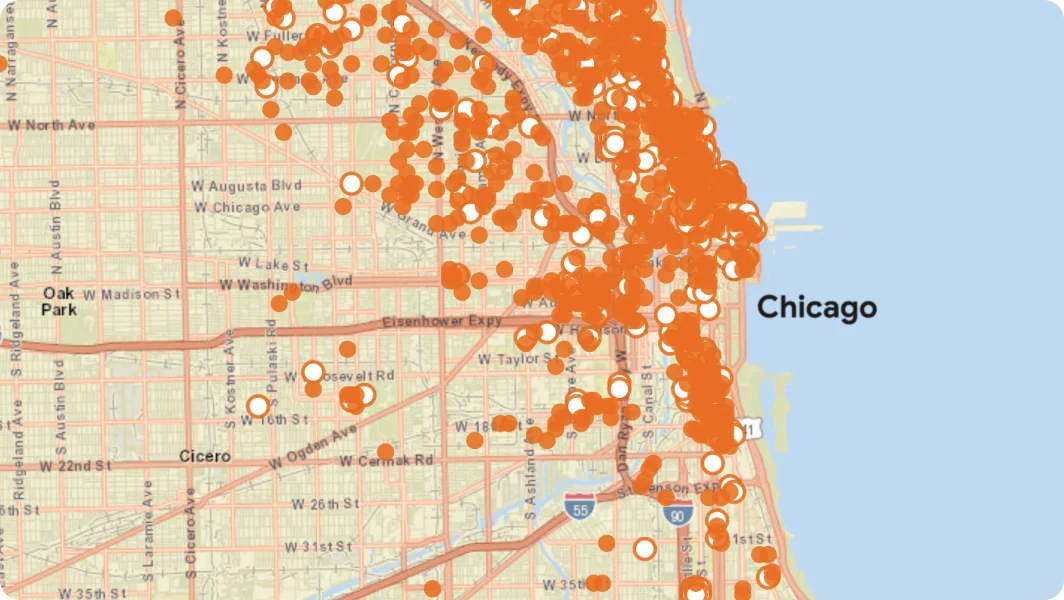
A building-by-building database of specific addresses where short-term rentals are completely banned. This is NOT a geographic zone map—it's individual buildings, not neighborhoods. Once a building is on the list, no units can register for short-term rentals—even if you own your unit.
Check your building:
How to use: Enter your property address in the map search. If your building appears, you cannot operate short-term rentals.
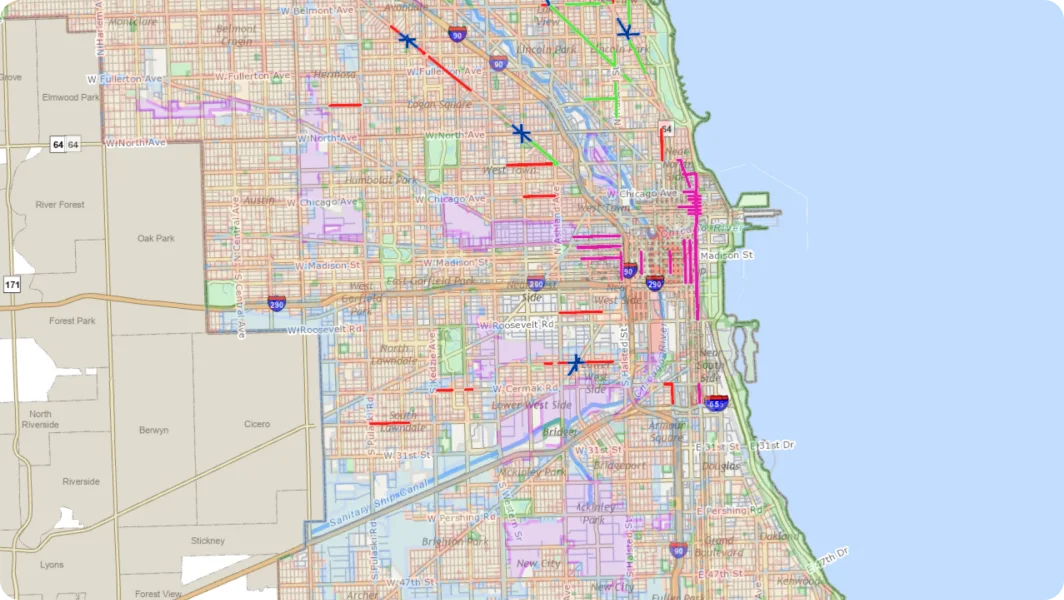
Neighborhood-level geographic limits where additional short-term rental restrictions may apply. Unlike Prohibited Buildings (specific addresses), RRZ restrictions apply to entire zones. Verify via Chicago Zoning Map or contact City Clerk's office.
Chicago's shared housing registration requires extensive documentation and careful attention to detail. The city cross-references every document against multiple databases, verifies insurance policies directly with carriers, and flags any inconsistencies for manual review. Most applications that get delayed or rejected fail because of missing paperwork, mismatched addresses, or incorrect building type classification.
Understanding which framework applies to your property is critical—wrong classification means automatic rejection and wasted application fees.
This covers most short-term rental hosts in Chicago. If you're renting out your home, a spare room, or a unit in a multi-unit building for stays of 31 days or fewer, you fall under this category.
Building type requirements:
If you own a single-family home:
If your property is in a 2-4 unit building:
If your property is in a 5+ unit building:
Key Takeaway: Primary residence requirement = you must live there 245+ days/year (about 8 months). City may audit and request proof through utility bills, voter registration, or tax records.
What is SHUOL? A separate business license required for anyone operating 2 or more short-term rental units anywhere in Chicago. The city treats multi-unit operators differently from individual homeowners—this license adds extra reporting requirements and oversight.
When you need it:
Fee: $500 for 2 years (as of 2026 municipal code; verify current fee at portal during application).
How to apply: Apply via Chicago Business Direct or in-person at City Hall—not through the shared housing registration portal. Apply only after your individual unit registrations are approved.
Monthly reporting requirement: SHUOL holders must submit data reports by the 15th of each month (bookings, nights, revenue per unit, guest count). Non-compliance can result in license suspension affecting all registered units.
Warning: SHUOL holders must file monthly data reports by the 15th. Missing reports = license suspension affecting ALL your units.

This only applies to buildings with 5 or more units.
Chicago limits how many units in a single building can operate as short-term rentals.
The absolute maximum: No building can have more than 6 STR units, regardless of size. Even a 200-unit high-rise can only have 6 registered short-term rentals.
The 25% rule: For smaller buildings, the cap might be lower. If your building has fewer than 24 units, calculate 25% of total units—that's your cap.
Examples:
Key Takeaway: No Chicago building can have more than 6 STR units, regardless of building size. Smaller buildings (under 24 units) have lower caps.
Don't rely on Airbnb listings. Many hosts don't advertise publicly. The city database is the only reliable source.

Chicago's application requires extensive documentation and the city actively verifies every detail. Your insurance carrier will be contacted directly. Your building address will be cross-referenced against multiple databases.
Where to apply: All Chicago short-term rental registrations are submitted through the city's official Shared Housing Registration Portal.
This is where you'll:
Address consistency is the #1 cause of application delays. Every document must show the identical address format.
What "Additional Insured" means: City is added as named party on your policy. Your insurance agent adds this via endorsement (typically form CG 20 10 or similar). Usually free, some carriers charge $25-50.
STR Insurance carriers:
Cost: $300-$600/year
Important: Homeowners insurance does NOT meet this requirement. STR hosting requires commercial liability coverage.
NOT required for units in 5+ unit buildings.
Provide 2 documents dated within 60 days:
Required when:
Letter must specifically mention "short-term rental" (generic sublet letters don't count), include signature from authorized party, date within 60 days, and property address.
Processing: 2-4 weeks. Common delays: mismatched addresses, missing "additional insured" endorsement, unclear floor plans.
Warning: Operating with expired registration = $1,500-$3,000 fines per month. Set renewal reminders 60 and 30 days before expiration.
.webp)
Chicago short-term rentals are subject to taxes from city, county, and state jurisdictions. Total combined tax burden: approximately 27-28% of gross rental charges.
City of Chicago (10.5% total):
Cook County: 1%
Illinois State: ~11-12% (Hotel Operators' Occupation Tax 6% + Sports Facilities Authority ~2% + MPEA ~2.5% + Municipal Hotel Tax ~1%)
Total: City (10.5%) + County (1%) + State (~11-12%) = approximately 27-28%
Platform collection: Airbnb and major platforms automatically collect and remit most lodging taxes for stays of 31 days or fewer as of 2026. Verify current status in your platform dashboard.
1. Report ALL income on tax returns (Federal Schedule E, Illinois Form IL-1040 Schedule E)
2. Track deductible expenses (registration fees, insurance, cleaning, supplies, maintenance, utilities, depreciation, SHUOL fee, Airbnb and platform fees)
3. Maintain records 3+ years (payout statements, booking confirmations, expense receipts, bank statements)
4. Quarterly estimated tax payments if income exceeds thresholds (Federal Form 1040-ES, Illinois Form IL-1040-ES)
5. Monthly data reporting if operating 2+ units with SHUOL (bookings, nights, revenue per unit, guest count—due 15th of each month, penalty = license suspension)
What the city tracks:
1. Platform monitoring - Data-sharing with Airbnb, Vrbo, Booking.com. Cross-references listings against registered units.
2. Neighbor complaint system - 2+ complaints within 90 days may trigger inspection.
3. Building cap audits - Quarterly verification. Newest registrations may be forced to non-renew if building exceeds cap.
4. Insurance verification - Random sampling. Expired policies trigger compliance notices.
5. Primary residence verification - Random audits for applicable properties. May require sworn affidavit.
Multiple neighbor complaints, suspected overcrowding (exceeding 1 guest per 125 sq ft), operating without valid registration, or safety hazards reported.
Inspectors verify: Registration posted, occupancy limits followed, smoke/CO detectors functional, fire extinguisher accessible, exits unblocked.
2-4 weeks from submission. Delays occur with mismatched addresses (40% of delays), missing "additional insured" endorsements (25%), or unclear floor plans (15%). Start 6-8 weeks before your planned launch.
Depends on building type: Single-family and 2-4 unit buildings require 245+ days/year primary residence. Buildings with 5+ units have no primary residence requirement.
You cannot register. The ban applies to the entire building. Check the Prohibited Buildings Map before purchasing.
$1,500-$3,000 fines per violation. Airbnb and platforms will delist your property. Operating with expired registration carries the same penalties.
Only if your building is 5+ units AND hasn't reached its cap (maximum 6 units or 25% of total units, whichever is less).
Renewal opens 60 days before expiration. Log into the portal, update information, pay $250. Process takes 5-7 days. Set reminders at 60 and 30 days before expiration.
Yes. Minimum $1 million commercial general liability that covers short-term rental activity. Must list "City of Chicago as Additional Insured." Cost: $300-$600/year. Homeowners insurance does NOT meet this requirement.
Most Chicago property owners spend 50-80 hours annually managing STR compliance—registration paperwork, insurance coordination, monthly reporting requirements, and deadline tracking. One missed renewal or incorrect document costs thousands in fines and lost revenue.
We help property owners navigate complex STR regulations so you don't have to become a compliance expert.
Start with a free 30-minute consultation. We'll review your property, walk through Chicago's requirements, and explain what it would take to handle everything yourself versus working with someone who does this full-time.
Disclaimer: This guide provides general information about Chicago STR compliance as of March 2026. Regulations and tax rates change periodically. Always verify current requirements with City of Chicago BACP, and consult a licensed attorney or tax professional for guidance specific to your situation.



%20Rules.webp)





Guest Experience &
After-Hours Support: