Local Insights


Houston, known as Space City for hosting NASA's Johnson Space Center and Mission Control, is also the Energy Capital of the World and home to the Texas Medical Center, the largest medical complex on Earth. That mix of steady business travel, medical visitors, and year-round conventions is part of why the city built a strong short-term rental market long before it had any rules governing one.
For most of its history, Houston had no short-term rental ordinance at all. That changed on April 16, 2025, when City Council unanimously passed Article XXIII, requiring every STR in the city to register. Full enforcement isn't quite here yet, and one of the most commonly repeated "requirements" online isn't actually real. Here's what the ordinance says, what it doesn't say, and what it means for anyone running a property in Houston today.
Yes. Airbnb, Vrbo, and any other short-term rental platform are legal to use in Houston, as long as the property has a valid Certificate of Registration from the city. There's no citywide ban, no zoning restriction, and no cap on how many short-term rentals can operate. The ordinance treats every platform the same way: if a booking runs fewer than 30 consecutive days, it's a short-term rental under city code, whether it's listed on Airbnb, Vrbo, or booked directly. Legal to use doesn't mean identical to use, though; each platform takes a different cut of what you actually earn.
Key takeaway: The platform doesn't matter for compliance. What matters is whether the specific property is registered and whether the rental itself complies with private deed restrictions or HOA rules, which the city doesn't check for you.
The ordinance defines a short-term rental as any dwelling unit, or portion of one, rented out for fewer than 30 consecutive days. That covers entire homes, individual rooms, apartment units, and condos alike.
A handful of uses are exempt: boarding homes, hotels, bed & breakfasts, licensed lodging facilities, buildings housing federally or state-regulated services, and leaseback arrangements where a seller rents a home back from its buyer.
Key takeaway: If you're renting any part of a Houston property for less than a month, the ordinance applies to you, no matter the platform.

Third-party market data (AirDNA, Rabbu, AirROI) puts the citywide average for an active Houston short-term rental somewhere in the $20,000-$31,000 annual revenue range, though estimates vary by source and methodology. This is a market average across thousands of listings, not a projection for any specific property. Revenue swings heavily by size and location: 4+ bedroom homes have averaged over $37,000 a year in some datasets, while studios run closer to $11,000, with smaller condos likely landing somewhat above that. A specific address can land well above or below any of these numbers depending on condition, location, and how it's managed. Properties near the Texas Medical Center, Downtown, and Montrose tend to see steadier demand, largely tied to the medical, business, and nightlife traffic those areas draw.
Seasonality here is real, but milder than a beach or ski market. Every data source agrees on one thing: January and February are consistently the slowest months, with monthly revenue running noticeably below the annual average. Where sources diverge is on the exact peak, some point to summer (July tends to lead), others to spring (March shows strength too, likely tied to conferences and events), and Houston's convention and sporting calendar can create additional short-term surges independent of season. Rabbu's data puts the swing between peak and trough at roughly 40-45%, a real but not extreme seasonal curve compared to markets that depend entirely on a single tourist season.
Before you count on any of that, though, the registration and tax obligations below come off the top.
This is the part most guides bury, and it's arguably more important than anything in the ordinance itself.
Houston has no zoning. It's one of the only major U.S. cities without one, and the city's own Planning Department says plainly that its codes "do not address land use." So the ordinance can require registration, but it has no zoning-based tool to say where an STR can or can't operate.
What actually decides whether your specific address can be rented by the night is your subdivision's deed restrictions, and Houston enforces these itself through its Legal Department, which can sue for an injunction under Chapter 212 of the Texas Local Government Code. Many older, generic "residential purposes only" deed restrictions don't bar short-term rentals outright. In Tarr v. Timberwood Park Owners Association (Texas Supreme Court, 2018), the court held that a bare residential-use covenant "merely limits the structure that can properly be erected... and not the activities that can permissibly take place in that structure." But plenty of newer or amended deed restrictions address rental duration directly, and those do hold up.
Key takeaway: A city registration certificate doesn't override your deed restrictions or HOA rules. Read yours line by line before assuming either way, and remember that the city's own application makes you swear your STR use doesn't violate them.

Every STR needs its own Certificate of Registration, applied for online through the Host Compliance registration portal. One certificate covers exactly one address; owning multiple units means multiple applications.
The city's official STR resource page has the full registration guide and video walkthroughs, but the short version is:
If your address doesn't show up correctly in the portal's list, the city's own guidance is blunt: stop, don't continue, and call 832-394-8802 or email STR@houstontx.gov instead of guessing.
If you're registering under an LLC or other entity, keep proof of good standing from the Texas Comptroller's Office on hand. The city doesn't require it upfront, but can ask for it on request.
Fees: $275 non-refundable application fee, plus a city administrative fee ($33.10 for 2025, adjusted annually). Certificates run one year from issuance, with renewal open up to 90 days before expiration. Certificates issued on or before December 31, 2026 all expire December 31, 2027, a transition rule worth double-checking against the actual date printed on your certificate rather than assuming.
Certificates are non-transferable, and the rule is broader than just resale: any change in ownership requires a brand new registration, not an update to the existing one. The same goes for your account email: change it after registering, and you lose access to the old email's registered properties, so use an address you plan to keep.
This is where Houston stands apart from most major markets and where a lot of guides get it wrong:
Houston short-term rentals collect hotel occupancy tax from guests, split across four charges that add up to the maximum Texas allows:
In practice: a $100/night booking carries an extra $17 in tax, paid by the guest on top of the nightly rate, not deducted from what you earn.
The good news: if you list exclusively on Airbnb or Vrbo, both platforms already collect and remit all four layers on your behalf for stays of 29 nights or fewer. You'll still need to upload proof of this at registration. List anywhere else, direct bookings included, and you're responsible for registering with Houston First and remitting the tax yourself.
This is the part most guides skip, and it's the most useful thing to actually know right now.
Operating, renting, or even advertising an unregistered STR carries a fine of $100-$500, and every day it continues counts as a separate violation. A month of unregistered operation can run from $3,000 to $15,000, against a $275 certificate.
The ordinance lets the city direct Airbnb, Vrbo, and other platforms to pull a listing that lacks a valid certificate, with a 10-business-day compliance window. The city has held off using this lever, and its own site states that platform delisting notices begin January 1, 2027. Through 2026, the fine is the enforcement tool; after that, delisting becomes the sharper one.
Houston runs a 24-hour hotline and an online complaint portal. Noise complaints go to the Houston Police Department, trash to Solid Waste Management, dangerous-building issues to Public Works, and fire code violations to the Fire Department.
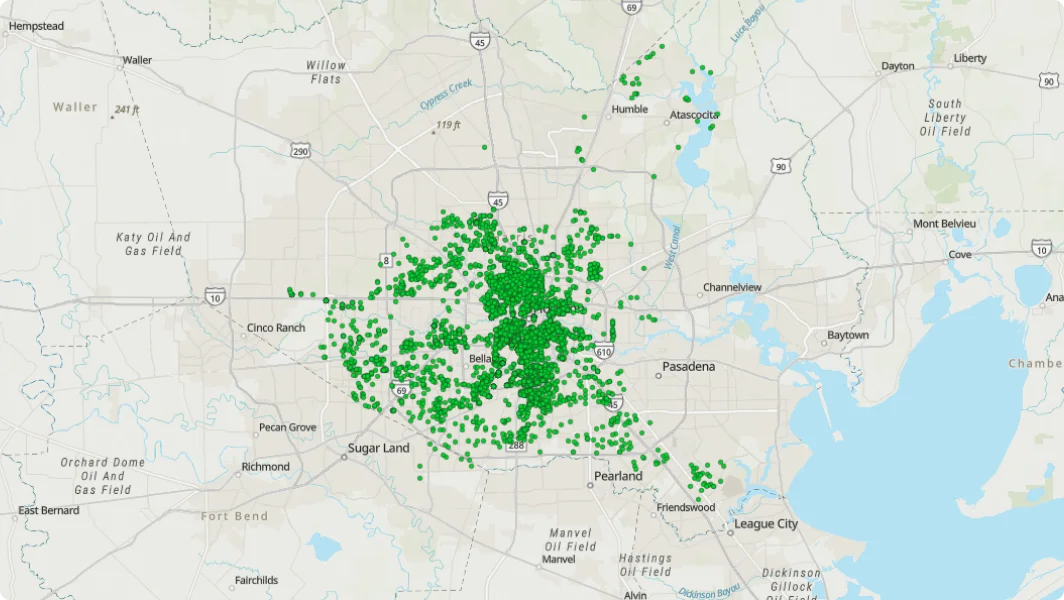
There's also a public map of every registered STR, showing 5,444 registered properties as of September 2026, which neighbors already use to check whether a nearby property is actually registered before filing a complaint. For context, the city had identified more than 8,500 short-term rentals operating across Houston as of late 2025, so a meaningful share of the market still hasn't registered.
Being registered means a property cleared the paperwork, not that its guests will be quiet. If you're managing a property (or living near one), the complaint system is where real disputes actually get resolved, not the registration status itself.
The clause is worth knowing if you own more than one property: if three or more of your certificates are revoked within any 24-month period, the city can move to revoke every remaining certificate you hold. This wasn't in the earliest draft of the ordinance, it was added specifically in response to concerns that owners with large portfolios could otherwise absorb a few revocations as a cost of doing business while continuing to operate everything else. A revoked certificate also makes you ineligible to reapply for one year.
Appeals go to an administrative hearing, filed within 20 days of the denial or revocation notice.
No. The city has stated directly that STR insurance is not required. Some guides online claim a $1 million liability policy is mandatory; that isn't accurate, and the figure appears nowhere in the ordinance.
Yes. City registration has no bearing on private deed restrictions or HOA rules, which are enforced separately through civil court, not the city. A generic "residential use only" restriction likely doesn't block STRs under Texas case law, but restrictions that specifically address rental duration usually do.
You're subject to fines of $100-$500 per day, with each day counted separately. Starting January 1, 2027, the city will also begin directing platforms to remove unregistered listings.
No. There's no cap on total STRs citywide or per owner. Each unit just needs its own certificate.
No. Houston has no owner-occupancy requirement, unlike many other major cities.
This guide reflects Houston's short-term rental ordinance as of Article XXIII, Chapter 28 of the City Code, current as of publication. Regulations change; verify current requirements with the City of Houston's Administration and Regulatory Affairs Department, and consult a licensed attorney for guidance specific to your property's deed restrictions.
Houston's registration system is more forgiving than most major markets, no zoning fights, no occupancy caps, no insurance mandate. But the paperwork, the tax layering, and the deed-restriction research still take real time to get right, and getting it wrong costs more than the $275 fee ever will.
If you're just getting started, here's how to get your first bookings and reviews without your new listing sitting invisible for weeks.
If you'd rather have someone who already knows this ordinance handle your registration, tax filings, and renewal deadlines, that's exactly the kind of thing we do for owners every day. Reach out to Triad Vacation Rentals and we'll walk through what your specific property needs.


%20Rules.webp)







Guest Experience &
After-Hours Support: