Local Insights

%20Rules.webp)
If you already own a home in Blue Ridge, Georgia, or the surrounding Fannin County area and you're weighing whether to list it short-term, the rules depend on one thing first: which side of the city line your property sits on. Blue Ridge the city and Fannin County the county run two completely separate short-term rental ordinances, and a lot of what's published online blends the two together or repeats numbers that are simply out of date.
Yes, with conditions. You need a certificate before you can legally list your home, and depending on where exactly it sits, the city may restrict whether you can get one at all. Here's what's actually on file with the city, the county, and the state, sourced directly from their own offices and reporting.
Here's the difference at a glance:
Start by figuring out which office you're actually dealing with. If you're not certain whether your address falls inside city limits or in unincorporated Fannin County, a call settles it in minutes:
.png)
Inside city limits, the process runs through the Planning and Zoning Department, and it starts with a question most guides skip: whether your property can get a certificate at all.
Per Section 10-193 of the city code, new short-term vacation rental certificates are only issued for property zoned Central Business District (CBD). If your home is zoned anything else, a fresh application will be denied outright, regardless of how strong the rest of your paperwork is.
Before you spend a dollar on photography or listing setup, confirm your zoning with the city, or check the city's official zoning district map directly.
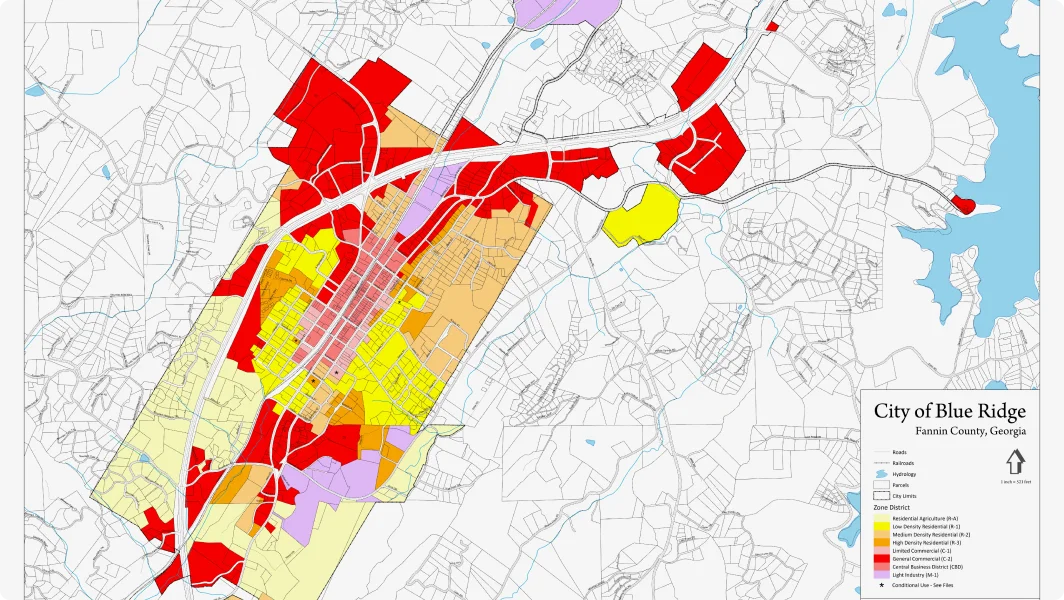
There's an important exception, though, and it's one most guides skip entirely: grandfathering. If a property was already operating as a short-term rental and paying its monthly hotel-motel tax before this rule took effect, it's allowed to keep operating even outside the CBD. That grandfathered status ends the moment the property changes ownership, with one carve-out: if the property is zoned C-1 (Limited Commercial) or C-2 (General Commercial), the grandfathered status survives a change in ownership too.
So if you're buying a cabin that's currently operating as a short-term rental, whether that status transfers to you depends entirely on the zoning code, not just whether the previous owner had a certificate.
If you're in an eligible zone (or grandfathered), you'll actually need two separate approvals from the city: the short-term vacation rental certificate itself, and a general Occupational Tax Certificate (the city's standard business license), which asks for details like your NAICS code and Georgia Sales Tax ID separately from the STVR-specific paperwork. Both have to be in place before you can legally operate.
The STVR application itself has to be notarized, and comes with its own checklist: a SAVE Affidavit verifying your citizenship or immigration status, a copy of a valid Georgia driver's license or other secure identification, a signed Letter of Agency if someone other than the owner is filing, and (for larger operations) an E-Verify affidavit.
Section 10-194 requires the application to also include:
Blue Ridge doesn't run a separate physical safety inspection as part of this process. What the city's ordinance calls "review of application" is a paperwork review handled by the city administrator or their designee, not someone coming out to walk through the property. Owners used to markets that require a fire marshal walkthrough or a formal certificate-of-compliance inspection before approval won't find that step here.
The certificate is not transferable. A change in ownership means a brand new application and a new application fee, not an update to the existing one. Applying for a certificate costs $25 (nonrefundable), and the annual permit fee is $100, paid to the city's planning and zoning department.
Operating without a valid certificate carries a minimum fine of $250 per occurrence, and each night or instance counts separately.
Hotel-motel occupancy tax and short-term rental occupancy tax reports are both due by the 20th of every month, and the city is explicit that this applies even in months with zero rentals. Pay late, and the penalty matches whatever late-payment penalty the city charges on property taxes, rather than a fixed short-term-rental-specific number.
Once you're certified, you're also required to list your certificate's identification number on your Airbnb, VRBO, or other platform listing, and to include that number on your monthly tax filings.
The certificate itself isn't a guaranteed right, either. The city's own application language states that it doesn't create a civil contract between you and the city, and the city council can revoke it at any time.

Outside city limits, there's no zoning restriction on where a short-term vacation rental can operate, but the county's own process has tightened considerably since 2025.
Fannin County revised its Short Term Vacation Rental Ordinance in August 2025, following public hearings on August 12 and 26 of that year. The county also passed a companion Environmental Health and Habitat Protection ordinance around the same time, which folds in noise regulations and a new "dark hours" lighting rule. Anything you read that predates August 2025 may be describing an older version of the process.
The current process, per the county's lodging department:
If Airbnb, VRBO, or another platform is remitting taxes to the county on your behalf as a marketplace facilitator, that does not cover your own reporting obligation. The county is explicit that owners are still responsible for entering their tax reporting figures monthly, due the 20th of each month for the prior month's activity, regardless of what the platform handles.
The county's fees, confirmed on its own application packet:
Certificates run on the calendar year and expire December 31. Miss that renewal date and you're looking at a $25 late penalty, and if the certificate lapses without renewal, the county treats it as a brand new application, meaning you have to meet every initial-issuance requirement again rather than simply renewing.
If you're buying a property that's currently operating as a short-term rental, there's a 30-day grace period to keep it running under the new ownership, but only if you or your management company submit the certificate application within 7 days of the sale closing.
Two physical requirements apply once you're certified. E-911 address markers have to be installed at the property. And a one-page Cabin Information Worksheet has to be posted visibly inside the rental itself, listing the property's 911 address, the nearest hospital, and a local point of contact who is reachable 24 hours a day, 7 days a week, and able to be on-site within 2 hours if needed.
That 2-hour, round-the-clock standard is stricter than the city's 24-hour phone-callback requirement, so if you manage properties on both sides of the jurisdiction line, don't assume the same contact arrangement satisfies both.
Here's what to have on hand before you start either application:
Here's what's actually on file with the Georgia Department of Community Affairs, which tracks the official rate each local government reports, since published guides disagree with each other on these numbers:
You'll see the county rate listed as 5% on some sites. That doesn't match what's on file with the state, in either the current report or the prior one. The DCA's Hotel-Motel Excise Tax Rate and Revenue Report is public and was most recently updated August 8, 2025.
On top of the local rate, every short-term rental in Georgia, regardless of city or county, also owes the state's flat $5 per night hotel-motel fee for stays of 30 days or less, on top of standard state sales tax.

Neither the city's ordinance nor the county's overrides a homeowners association rule or a deed covenant. If your property is in a community with an HOA, check your governing documents before you apply for a certificate. A city or county approval doesn't help you if your HOA prohibits short-term rentals outright.
Yes. You need a Short-Term Vacation Rental Certificate and a separate Occupational Tax Certificate from the city, and your property has to be zoned Central Business District unless it qualifies for grandfathered status.
Unincorporated Fannin County charges a 6% local hotel-motel excise tax. Inside Blue Ridge city limits, it's 8%. Both are on top of Georgia's flat $5-per-night state hotel-motel fee and standard state sales tax.
Even when a platform remits taxes as a marketplace facilitator, Fannin County still requires you to report your figures monthly yourself. Platform remittance doesn't replace your own reporting obligation.
County certificates expire December 31 each year. Miss it and you owe a $25 late penalty. If it lapses without renewal, the county treats your next application as brand new, meaning you have to meet every initial-issuance requirement again.
No, not automatically, in either jurisdiction. The city's certificate isn't transferable at all; a change in ownership requires a new application and fee. The county allows a 30-day grace period to keep operating under new ownership, but only if you submit a new application within 7 days of closing, plus a $50 transfer fee.
No. The city's process is a paperwork review conducted by the city administrator or their designee, not an on-site safety inspection.
Inside city limits, apply through Blue Ridge Planning, Zoning and Permitting. In unincorporated Fannin County, apply through the county's Lodging Department. Which office you need depends entirely on which side of the city line your property sits on.
Blue Ridge and Fannin County aren't unregulated, and the August 2025 update makes that clearer than ever. But the rules are also genuinely manageable once you know which office to deal with and what they actually ask for. Get the paperwork right at the start, and getting booked and priced competitively becomes the more interesting problem to solve.











Guest Experience &
After-Hours Support: