Industry Insights
How Much Do Airbnb, VRBO, and Booking.com Really Charge? A Complete Fee Breakdown


Updated on:
October 16, 2026


A platform's fee is not just a percentage: it decides how much of every booking actually stays with you. Airbnb charges most hosts 15.5%, Vrbo moves to a single 12% commission on October 29, 2026, and Booking.com sets a commission for each property, typically around 15% in the US. This guide shows what each platform takes, what guests pay on top, and how one real booking pays out.
Note: The Vrbo examples in this guide use the current rate, about 8% for bookings made until October 28, 2026. From October 29, Vrbo moves to a single 12% commission, and what the new commission means for hosts is covered in a separate guide.
The table below uses one example, a 3-night stay of $1,000 in total, cleaning fee included, so the fees can be compared directly. Taxes and a manager's fee are added in the full breakdown near the end of this guide.
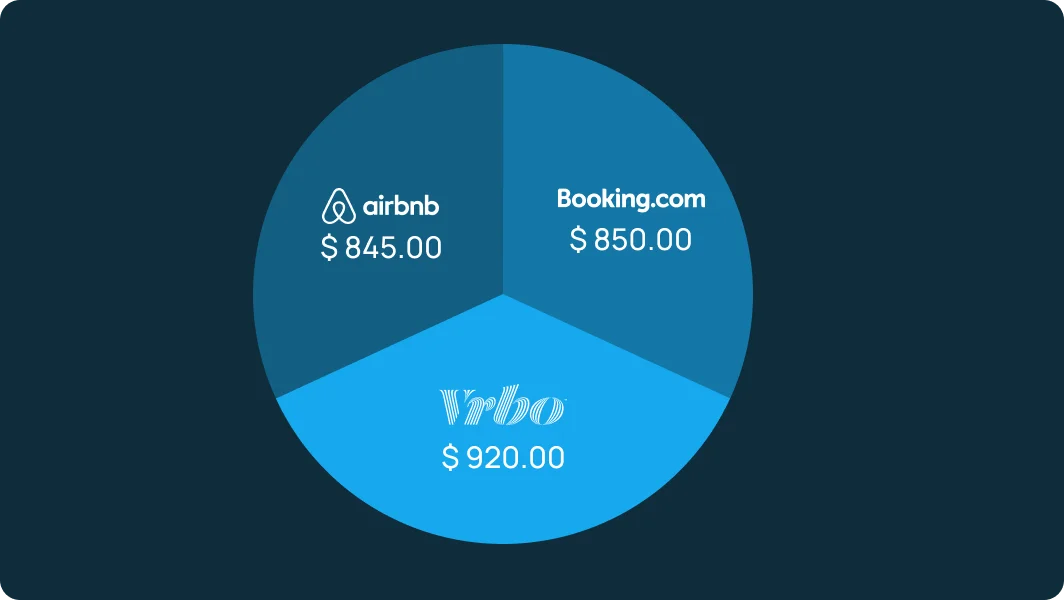
On a $1,000 stay, the same booking leaves the host between $845.00 and $920.00 depending on the platform, before any guest fees, processing fees, or taxes.
A note on pricing: You can list the same home on Airbnb, Vrbo, and Booking.com at once and keep one calendar through a property management system or channel manager, but pricing is where the platforms affect each other, because each one takes a different share and some set rules about how your prices on other channels can differ. Check each platform's current terms before pricing channels separately.

Each platform charges differently, and the differences show up in what the host keeps and what the guest sees at checkout.
Airbnb uses a host-only fee: most hosts pay a flat 15.5% commission deducted from each payout, and guests see no separate platform fee at checkout. The fee is calculated on the nightly rate and the cleaning fee, not on taxes. How the change works for managed homes is covered in our guide to Airbnb's new 15.5% host-only fee.
Example: on a $1,000 stay, the guest pays $1,000 and the host keeps $845.00 after Airbnb's fee.
What works
What to watch
Update: Vrbo has announced that from October 29, 2026, hosts move to a single 12% commission, which Vrbo's Help Center says includes payment processing. The 12% applies to bookings made on or after October 29, so reservations made earlier keep their current rate, and the figures in this section describe that earlier model. The new commission is explained in a separate guide.
For bookings made until October 28, hosts on pay-per-booking pay 5% when connected through a property management system, and about 8% (a 5% commission plus 3% payment processing) when listing without one. Vrbo shows guests a service fee on top of the nightly rate and does not publish the amount, and in our management experience that higher checkout total is the main thing to watch when setting prices on the platform. The annual subscription is a legacy option that Vrbo is phasing out, and it moves to pay-per-booking at the end of the term.
Example: on the same $1,000 stay, the host keeps $920.00 at 8% for a booking made until October 28, and $880.00 at 12% for a booking made from October 29.
What works
What to watch
Booking.com takes a commission on every reservation, and the exact percentage is set in your agreement instead of being published as one rate. In the US it typically runs from 10% to 25%, with around 15% as the average, depending on the market and the type of property. Programs such as Genius, Preferred Partner, and Visibility Booster can push the commission above the rate in your contract.
The commission covers the stay and any extra fees added at booking, such as cleaning fees, but not local taxes. Guests are not charged a separate Booking.com service fee, so the price you set is the price they pay. If you use Payments by Booking.com with bank transfer payouts, a processing fee of 1.1% to 3.1% applies on top, depending on the property's location.
Example: at 15%, the host keeps $850.00 on the same $1,000 stay, before any processing fee.
What works
What to watch

If you plan to hire a property manager or a co-host, their fee sits on top of what the platforms take, and what matters most is what the fee covers and the amount it is calculated on.
Fees vary widely with the scope of service. Lighter-touch management, where the owner still handles cleaning and on-site maintenance, is commonly quoted at 10% to 15%, while full-service management is commonly quoted at 20% to 35%. Airbnb also has its own Co-Host feature for adding someone to help run a listing, and the fee is agreed directly with the co-host.
Triad's management fee is 10% to 15% of your payout, under a single management plan with no tiers or add-on fees, and it covers pricing, listing management, and performance tracking while cleaning and on-site maintenance stay with the owner. The fee is calculated on what you earn after platform fees and taxes, not on what the guest pays, so it moves with your revenue. The percentage for your property is set in your service agreement.
To show the range, take a booking where the host keeps $845.00 (the Airbnb example in this guide). A 10% fee is $84.50 and leaves you $760.50, while a 15% fee is $126.75 and leaves $718.25. The same calculation applies to Vrbo and Booking.com payouts.
Triad manages listings across multiple platforms at once, using dynamic pricing strategies to keep booking totals competitive for guests. You do not manage pricing yourself, because Triad's team handles rate adjustments across all platforms based on demand, market conditions, and platform-specific dynamics.
Tax handling differs by platform and by location, and in the US it decides how much work lands on the owner: some taxes are collected and remitted by the platforms, and the rest are handled by the owner or by someone hired to do it, such as a property manager, a lodging tax service, or a CPA.
Lodging taxes, also called occupancy or transient taxes, are a tax on the stay that the guest pays, added to the bill at booking. There is no national lodging tax: rates and rules are set by states, counties, cities, and sometimes special districts, so one property can owe taxes to more than one authority. The host or property manager is responsible for making sure the tax is collected and remitted to the right authority.
Booking platforms can do part of this work. In the areas where a platform collects and remits taxes, it adds them to the guest's bill and pays them to the authority on your behalf, but you may still need to register and file returns yourself. Wherever a platform does not collect, the whole process falls to the owner or property manager.
Airbnb collects and remits lodging and occupancy taxes on your behalf only in the areas where it has an agreement with the local government or is required by law to. Airbnb's list of areas names most US states, but being on the list does not mean Airbnb collects every tax there, because coverage differs by state, county, and city.
Where Airbnb does not collect a tax, it stays your responsibility. Airbnb's own state pages, such as the one for Washington, list the taxes it collects and note that hosts remain responsible for all other state and city obligations. For each property, that comes down to three questions: which taxes apply, which of them Airbnb collects, and who files the rest.
You may also still need to handle income taxes or specific local requirements. For US hosts, Airbnb reports earnings via Form 1099-K if thresholds are met.
Vrbo collects and remits lodging taxes in the jurisdictions where it is required to, so coverage depends on the state and city. Any tax Vrbo does not remit stays with the owner.
Booking.com collects and remits taxes in some US states for reservations paid through Payments by Booking.com, so coverage again depends on the state. For pay-at-property bookings and wherever Booking.com does not remit, the owner is responsible for collecting and filing.
On direct bookings no platform collects anything, and the same applies to any tax a platform does not remit, so you register, collect, and file it yourself. Owners usually handle that in one of three ways:
In some jurisdictions, local taxes are payable directly by the owner, so the right setup depends on where the property is.
This guide is general information and does not provide tax, legal, or accounting advice. Tax obligations vary by jurisdiction, so consult a qualified tax professional to determine the right filing, remittance, and compliance requirements.
This breakdown uses the same 3-night, $1,000 stay as the table above and adds the taxes and a manager's fee, so you can follow the full path from what the guest pays to what the owner keeps.
Note: Taxes are examples only and vary by jurisdiction, and they are collected from the guest on top of the stay. Each platform fee is applied to the $1,000 total: Airbnb 15.5%, Vrbo 8% (the current rate, which becomes 12% for bookings made from October 29, and its guest service fee is not published), and Booking.com 15% before its processing fee (1.1% to 3.1% with Payments by Booking.com). The manager's fee is calculated on the host payout after the platform fee and is shown at 10% as an illustration, not a quote.
Every platform fee comes out of the booking total, so the price you list is not the amount you keep. To receive a target amount, divide it by 1 minus the fee: target payout ÷ (1 − fee).
The table shows what that means at common fee levels, for a target payout of $880.00 and a cleaning fee that has to leave $100.00 after the fee.
Platforms charge their fee on the cleaning fee too, so a cleaning cost of $100 needs a higher cleaning fee to cover it. Some platforms also limit how far your prices on other channels can differ, so check each platform's current terms before pricing channels separately.
From October 29, 2026, Vrbo charges hosts a single 12% commission that Vrbo's Help Center says includes payment processing. It applies to the rental amount and to fees such as cleaning and pet fees, and it follows the date the booking was made.
Because each platform takes a different share: on the $1,000 example, the host keeps $845.00 on Airbnb at 15.5%, $850.00 on Booking.com at 15%, and $920.00 on Vrbo at 8% ($880.00 at 12%). Guest-side fees also differ and raise what some guests see at checkout, so the lowest host fee does not always mean the best result.
No. Airbnb's 15.5% is calculated on the booking amount (nightly rate plus cleaning fee). Taxes are collected separately and, in the areas where Airbnb collects them, remitted by Airbnb, so they do not reduce your payout further.
Yes, all three do. Airbnb applies its fee to the nightly rate and to fees the host charges, Vrbo applies its 12% to the rental amount and to additional fees such as cleaning, pet, and boat fees, and Booking.com applies its commission to the stay and to extra fees added at booking. Taxes are not part of the commission base.
In some cases, yes. Booking.com charges commission on non-refundable bookings, and on no-shows and late cancellations when you charge the guest.
Yes, by taking bookings directly. A booking made through your own website or booking system does not pay a platform commission, but you still need a website, a way to take payments, and marketing to bring guests in, and card payments carry their own processing fee. Platforms bring visibility and volume, so direct bookings usually work best alongside them rather than instead of them.
A manager's fee pays for work that is hard to do alone: pricing across several platforms at once, listing management, and performance tracking. Whether it is worth it depends on how much of that you want to handle yourself and what your time is worth.
Airbnb is typically the strongest channel for short-term rentals, and we manage homes across all three platforms with pricing built around Airbnb demand. The right mix still depends on your market and guest profile.
Platform fees, taxes, and who runs the listing all change what actually reaches the owner, so the best platform is not the one with the lowest percentage. It is the one that leaves the most after every cost.
Platform fees, taxes, and management costs all change how a booking is priced and what reaches the owner. Triad Vacation Rentals sets up and optimizes listings across Airbnb, Vrbo, Booking.com, and its own booking site, and our team can walk through what these fees mean for a specific home. Schedule a call when you want to go through the numbers for your property.











Guest Experience &
After-Hours Support:


