Industry Insights
US Vacation Rental Booking Behavior 2026: How Guests Choose on Airbnb, Vrbo & Booking.com


Updated on:
June 17, 2026


US vacation rental guest behavior shifted dramatically in 2026. Analysis of 200+ properties across five southeastern states reveals a compressed decision model. Guests now filter and abandon listings in under 30 seconds, prioritizing Instant Book availability (30-50% filter exclusively), transparent pricing (cleaning fees above 15-17% kill conversions), and real photos over AI-generated images (12-25% conversion gap). Mobile bookings dominate at 55-60% (65%+ in urban markets), while booking windows compressed to 7-14 days in major metros—down from 16-18 days in 2025. Last-minute demand (0-14 days) now represents 35-52% of bookings in high-traffic markets like Florida.
The traditional About page and host storytelling are largely ignored. Guests trust transparency and peer reviews over narrative. The 5-gate decision model—Instant Book → Availability → Price → Photos → Rules—dominates high-inventory urban markets, but luxury properties ($500+ ADR), extended stays (7-30 nights), and rural estates follow different patterns where Vrbo, direct bookings, and relationship-driven reservations still work effectively.
Key insight: Properties optimized for how guests actually decide in 2026 consistently outperform those relying on 2024 strategies.
.webp)
Two years ago, a guest might have read your About page, looked at your photos, and made a decision based on the "vibe" of your property.
Today, guests move faster and prioritize different signals. If your listing doesn't speak to what they actually care about, they scroll past in seconds.
What's changed: Airbnb data for 2026 shows US guests are booking faster and more spontaneously—especially shorter stays (1–3 nights) and last-minute trips. The booking window has compressed significantly in major metros. And here's the critical part: over 55–60% of US vacation rental reservations now come from mobile devices (with urban markets reaching 65%+)—which means clarity and speed matter exponentially more than they did in 2025.
Additionally, 30–40% of US travelers now use AI tools extensively (ChatGPT, Claude, Gemini, Perplexity) to plan their trips and research accommodations, with occasional usage approaching 55%. Guests are arriving at listing pages with pre-formed expectations—they're shopping with purpose, not browsing aimlessly.
In 12 months, guest behavior accelerated dramatically. What was "nice to have" in 2025 became "must have" in 2026.
Before they even see your listing details, many guests filter to Instant Book only.
This is brutal for hosts who require approval. If you don't have Instant Book enabled, a significant portion of guests never see your property. They literally can't book without messaging you first, so they don't bother.
This year, Instant Book isn't optional—it's baseline. Guests want zero friction, and waiting for host approval creates friction.
The data backs this up: Properties with Instant Book enabled show 8–15% higher RevPAR compared to approval-required listings in competitive US markets. In major metros and high-demand destinations, estimates suggest that 30–50% of guests filter by Instant Book—with adoption reaching 60% in the most competitive urban markets. The Airbnb algorithm also prioritizes Instant Book properties in search rankings.
Why it matters: In competitive US markets, a significant portion of travelers never even see listings that require approval. They filter them out before they scroll.
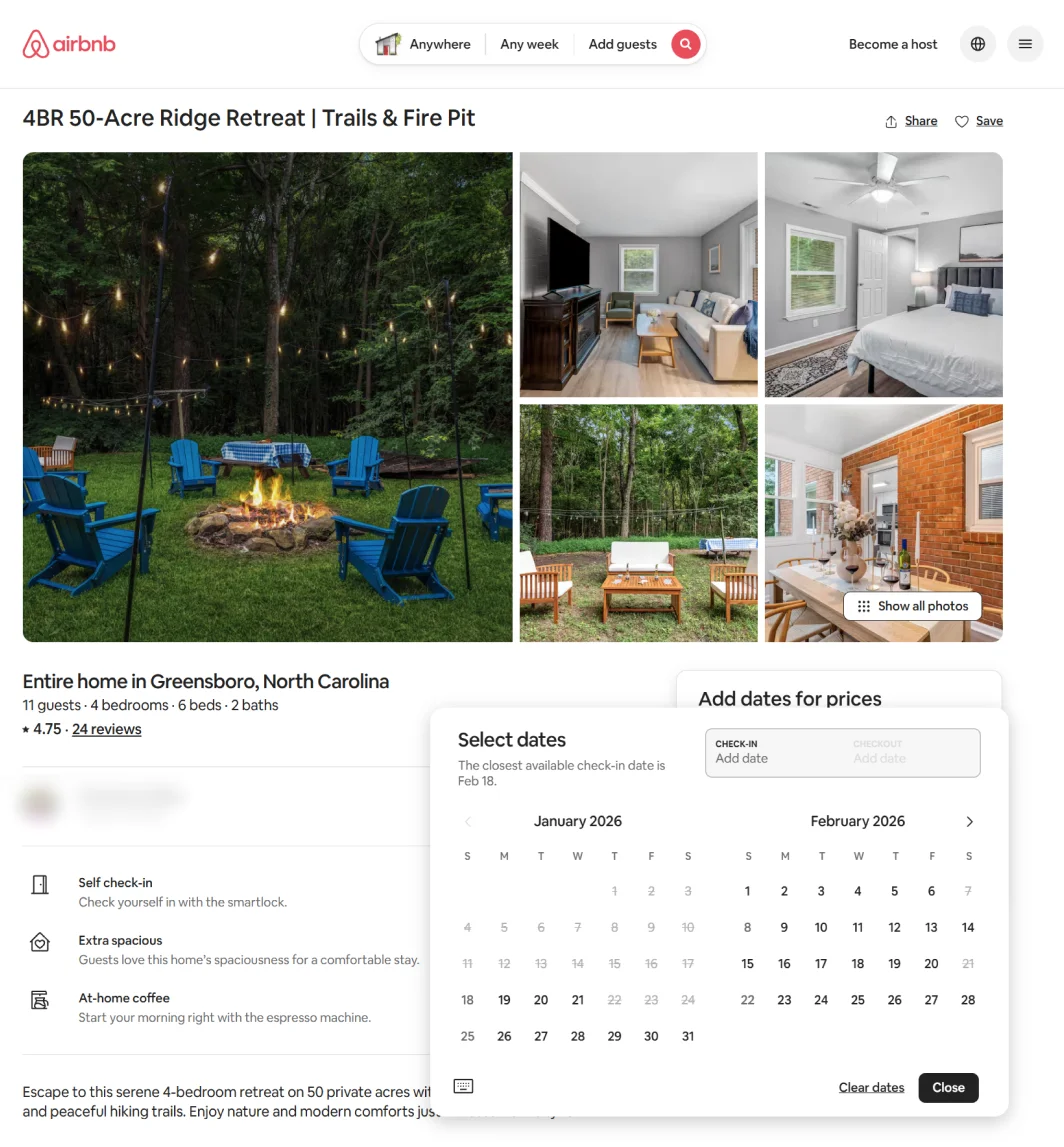
After filtering for Instant Book, guests check: Can I book when I need to?
An open calendar isn't just availability data. It's a signal. It tells the guest:
A blocked calendar isn't just a scheduling tool—it's a signal. For guests, a blocked calendar means either "not available" or "too complicated to deal with." So they move on to the next listing.
Properties with consistently open calendar availability across all platforms capture significantly more last-minute bookings in compressed booking window markets.
This is where sorting actually starts. Guests filter by price range, then look for trust signals.
Guest Favorite and Airbnb Plus badges matter enormously on Airbnb. Vrbo has Top Rated and Verified Owner badges. Booking.com uses Genius and Genius Plus designations. Many guests don't read anything—they just filter by badge, price, and open dates. If you have the badge and the price is right, you're in. If you don't, you're competing harder.
But here's the trap: hidden fees kill conversions. If your nightly rate looks good but the cleaning fee is 20%+ of the total cost, guests see the breakdown at checkout and bail.
In 2026, the average cleaning fee in the US hit $170–175 per stay (AirDNA 2025 reported $161, with 2026 trending higher). But here's the critical threshold: anything over 15–17% of the total booking price becomes a red flag. Guests do the math fast. They see $150/night + $80 cleaning fee on a 3-night stay and think "That's not what I'm paying."
This threshold becomes more critical when factoring in platform service fees across Airbnb, Vrbo, and Booking.com, which compound the total cost guests see at checkout.
This is where many good listings die. Great property, reasonable price, but the fee structure feels like a gotcha. Airbnb's 2025 decision to show total pricing upfront means guests now see these fees immediately—there's nowhere to hide. And when fees exceed 15–17%, checkout abandonment significantly increases (industry estimates suggest 20–30% higher abandonment rates).
Analysis of 1,800+ reservations over 12 months across active properties in 34 states:
Cleaning Fee Reality by Market Type:
Coastal & High-Tourism Markets:
Urban & Mixed Markets:
Inland & Extended-Stay Markets:
Key insight: Cleaning fee dollar amounts are remarkably consistent across markets ($220-250 for most properties). However, percentages vary dramatically based on booking size and length of stay.
Florida's 27% reflects shorter average stays (3-4 nights at $165/night = $1,440 total) compared to Tennessee's 14% on longer stays (5-6 nights at $372/night = $2,135 total). Both states charge essentially the same cleaning fee in dollars (~$230-245), but the denominator makes Florida appear higher as a percentage.
Guest review correlation:
Bottom line: The 15-17% "threshold" may be more perceptual than operational—guests react to the percentage displayed at checkout, not the underlying cost structure. Markets with shorter average stays (coastal, urban weekenders) will always show higher percentages even when charging market-standard cleaning fees.
Note: US vacation rental industry average is $170-175 per stay (AirDNA 2025). Our portfolio averages $244 across major markets, reflecting larger vacation homes (typically 3-5 bedrooms) in higher-cost coastal and urban locations.
By this point, if you've passed Instant Book, open dates, price, and badges—guests finally look at photos.
But here's what hosts get wrong: they optimize the full photo gallery. What actually matters is the first 5–7 photos.
Industry data consistently shows that these first photos are the decider—if they don't work, guests don't scroll deeper. They move on.
This is also where AI-generated and stock photos backfire. Guests have developed radar for fake images. A listing that looks too perfect, too polished, too staged—guests recognize it and assume there's a gap between the photos and reality.
Real photos (even if imperfect) convert better than perfect AI renderings. In 2025, hosts who switched from AI-generated images back to real property photos reported improved conversion rates and better guest reviews citing "photos match reality."
Current data shows an even clearer picture: real photos outconvert AI-generated images by 12–25% on average (PriceLabs & host community tracking).
Professional photography that captures authentic property conditions—rather than staged or AI-enhanced imagery—consistently demonstrates higher conversion rates in competitive markets.
Once they've decided the photos look good, guests want specifics:
Rules need to be explicit. No ambiguity. No "we can discuss."
Clarity works: "Check-in: 3 PM. Check-out: 11 AM. No exceptions." | "Pets: Not allowed." | "Cancellation: Free until 7 days before. After that, 50% charge."
Vagueness kills bookings: "We're flexible on check-in/check-out depending on schedule." | "We can discuss pets on a case-by-case basis."
Specific, concise property descriptions consistently outperform lengthy storytelling in booking conversion metrics.

Your story and long descriptions — The About page where you explain how you found the property, why you love it, what makes it special—guests skip this. Long paragraphs about "rustic charm" or "modern minimalism" don't move the needle. Guests want facts they can scan, not adjectives.
Why you're special — You might be a great host. That matters after the booking. Before the booking, what matters is: Can I book when I need to? What are the rules? What's included?
Tools and interfaces changed — Airbnb, Vrbo, and Booking.com now prioritize availability filters, detailed amenity checklists, and instant confirmation over narrative storytelling. The About page has nowhere to live in 2026 interfaces.
Speed and options matter more — Guests have exponentially more choices than they did even two years ago. They're scrolling faster, deciding in minutes, and moving on immediately if something feels unclear or complicated.
Trust shifted from narrative to transparency — Guests now trust clear dates, explicit rules, and transparent pricing more than beautiful stories about why you love the property. Reviews from other guests have completely replaced host storytelling as the primary trust signal.
Understanding guest behavior isn't about judgment—it's about recognizing a fundamental shift in how US travelers shop and decide.
Instant Book signals competence and reduces friction — Guests no longer want to wait for approval. If they can't book instantly (or nearly instantly), they perceive the property as harder to deal with and move on to the next option.
Open calendars mean "ready to book" — A blocked calendar tells guests the property is either unavailable or complicated. An open calendar signals "I'm managed well, and I'm ready for you right now."
Transparent pricing prevents distrust and abandonment — When cleaning fees exceed 15–17% of the total, guests see it as hidden cost, not justified pricing. The result is measurably higher checkout abandonment.
The first 5–7 photos are the decision point — Guests decide in the first 7 seconds. If those photos don't look real and trustworthy, they leave. Real photos consistently outperform over-polished or AI-generated images.
Clear rules create confidence, vague rules create anxiety — When house rules say "we can discuss," guests interpret that as "this will be complicated." Non-negotiable clarity makes guests more comfortable booking, not less.
Booking pattern analysis across 200+ properties in major southeastern metros (12-month period):
Booking Window by Market:
Operational reality:
More than half of Florida revenue comes from guests who decide in the last two weeks. Properties with blocked calendars or "pending availability" are invisible to this segment—which now represents the majority of demand in high-traffic metros. Dynamic pricing strategies help properties capitalize on these compressed booking windows.
What the data shows: Markets with shorter booking windows (Florida, Texas) also show higher price sensitivity and higher last-minute booking percentages. This pattern is emerging across urban vacation rental markets nationwide, with coastal and event-driven destinations leading the shift.
Reviews are the only narrative that matters — Guests trust other guests 100x more than they trust your words. One negative review that says "photos didn't match" destroys conversions faster than 10 positive reviews about how much the host cares.
The pattern: Guests have moved from seeking reassurance (through stories) to seeking certainty (through data and transparency). They're not being more demanding—they're just being more efficient.

Here's the thing: the decision process is the same across Airbnb, Vrbo, and Booking.com, but how guests access information differs by platform interface and speed.
All three platforms now prioritize: (1) Instant/Quick booking filters, (2) Calendar availability, (3) Total price with fees, (4) Trust badges and reviews, (5) Photo galleries. The 5-gate model applies universally.
Based on 3,500+ reservations across a 200+ property portfolio spanning 34 US states (12-month analysis):
Booking Channel Breakdown:
Market insight:
Despite multi-channel distribution, nearly 6 in 10 guests choose Airbnb in this portfolio. This isn't just platform preference—Airbnb's filtering tools (Instant Book, availability, badges) and mobile interface drive the highest traffic and conversion rates in the vacation rental segment.
Direct bookings represent a small but strategically important segment—many of these guests discovered properties on OTAs first, then booked direct on return visits.
Booking.com drives minimal vacation rental volume in this data set, suggesting guest behavior on that platform still skews heavily toward hotels rather than STRs—a pattern observed across many US vacation rental portfolios.
Note: Channel mix varies significantly by market type, property positioning, and regional traveler preferences.
What this reveals: Guests use the same 5-gate process on all platforms (Instant Book → Availability → Price → Trust signals → Photos). The difference is interface and speed, not decision logic. Properties that nail availability, transparent pricing, and real photos win everywhere.
While the 5-gate decision model applies broadly across US vacation rentals, certain property types and guest segments follow different patterns:
Luxury properties (ADR $500+):
Extended stays (7-30+ nights):
Rural estates and unique properties:
Bottom line: The compressed decision model (30 seconds, 5 gates) reflects high-inventory urban markets where guests have 50+ similar options. In low-inventory or high-touch segments, traditional relationship-driven booking still works effectively.
Properties that guests book repeatedly share these characteristics: Instant Book enabled, open calendars, honest pricing (no surprise fees), earned badges (Guest Favorite/Plus), strong first 5–7 photos (real images, not AI), clear rules, detailed amenity lists, and strong reviews.
The About page still exists. But the decision happens in the first 30 seconds:
Only after those five gates pass do guests look at rules and amenities.
Build for those 30 seconds, and the rest follows.
Guests filter by Instant Book availability first, then check calendar openness and transparent pricing. If any of these three gates fail, they move to the next listing immediately without reading property descriptions or reviews.
Industry data suggests 15-17% of total booking price as the threshold where checkout abandonment increases. However, this varies by market—coastal tourist markets consistently operate at 22-27% due to shorter average stays, while inland properties with longer stays show 13-16%. The percentage matters more than the dollar amount in guest perception.
Yes. Properties with Instant Book enabled show 8-15% higher RevPAR in competitive markets. In major metros, an estimated 30-50% of guests filter exclusively by Instant Book, meaning approval-required properties lose significant visibility to motivated buyers.
Yes. Real property photos outperform AI-generated images by 12-25% in conversion rates. Guests have developed radar for over-polished or staged images and associate them with misleading listings. Focus on authentic photos even if they're not perfectly styled.
Major metros now average 7-14 days from booking to check-in, down from 16-18 days in 2025. Last-minute bookings (0-14 days) represent 35-52% of demand in high-traffic coastal markets. This means properties need immediately available open calendars to capture revenue.
Not entirely. Luxury properties ($500+ ADR), extended stays (7-30 nights), and rural estates follow different patterns. These segments see longer booking windows (30-60 days), higher About page engagement, and stronger performance on Vrbo and direct booking channels where relationship-driven booking still works effectively.
Focus on the first 5-7 photos. Industry data shows guests make decisions within 7 seconds of viewing photos—if the first few don't convert, they don't scroll deeper into the gallery. Prioritize quality over quantity for the opening images.
We manage 200+ vacation rental properties across 34 US states and track metrics across cleaning fee structures, booking windows, review sentiment, and channel performance.
If you manage 5+ properties and want a complimentary listing performance review:
The shift in US guest behavior is measurable and ongoing. Properties that adapt to how guests actually decide in 2026 consistently outperform those relying on outdated strategies.
.webp)


.webp)
.webp)
.png)



Guest Experience &
After-Hours Support: