Industry Insights
How to Write Vacation Rental Descriptions That Convert (2026 Guide)


Updated on:
January 20, 2026


You've got great photos, 5-star reviews, and competitive pricing. So why are guests viewing your listing but not booking?
The answer is often in your description.
78% of Airbnb guests read the full listing copy before making a booking decision. Yet most hosts write generic descriptions that sound like everyone else's: "Beautiful home," "fully equipped kitchen," "great location."
Your listing description isn't just information—it's your pitch. Combined with professional property photography, it converts browsers into bookers. It answers unspoken questions and sets accurate expectations that lead to 5-star reviews.
This comprehensive guide shows you exactly how to write descriptions that convert across Airbnb, VRBO, and Booking.com—with real before/after examples and platform-specific strategies.
When potential travelers land on your property listing, they've already scrolled through dozens of similar options. Your copy is your chance to differentiate your property. Answer the questions running through their minds: Will this meet my needs? Is this worth the price? Can I trust this host?
Quality descriptions matter measurably. According to a 2025 market analysis, properties with strong listings are 35% more likely to outperform their market average. Why? Clear, specific copy reduces guest hesitation, leads to better-matched bookings, and results in fewer cancellations and negative reviews.
You're not being deceptive; you're being clear. You're answering questions before guests have to ask them. You're painting a picture of what their stay will look like.
The best descriptions don't just list features—they tell a story. They help visitors envision themselves in your space, enjoying their time there. They build confidence and reduce hesitation.

Before writing, you need to understand where you're writing. While Airbnb, VRBO, and Booking.com all serve the short-term rental market, each platform has slightly different audiences, expectations, and technical specifications.
Airbnb emphasizes authenticity and personality. The platform caters to diverse travelers: backpackers, families, business travelers, and digital nomads. Keep descriptions conversational and genuine.
Airbnb's algorithm also favors properties that maintain high response rates and positive reviews, so copy that helps attract the right guests (and deter the wrong ones) is valuable.
Airbnb gives you multiple text fields: the headline, "The Space" description, "The Neighborhood" description, and "House Rules." This segmented approach lets you be very specific about different aspects of your property.
VRBO historically attracted families and groups looking for vacation homes. The platform focuses on larger properties and longer stays. Listings on VRBO tend to be longer and more detailed, which the audience appreciates.
VRBO's search algorithm prioritizes completeness and detail. Properties with thorough write-ups tend to rank higher. The platform also has a strong reviews component, similar to Airbnb.
Booking.com is known for its strict policies and data-driven approach. For a detailed comparison, see how platform fees stack up across Airbnb, VRBO, and Booking.com. The platform caters to all types of travelers and emphasizes quick, clear information.
Booking.com limits your description space slightly more than the other two platforms, making brevity and impact crucial.
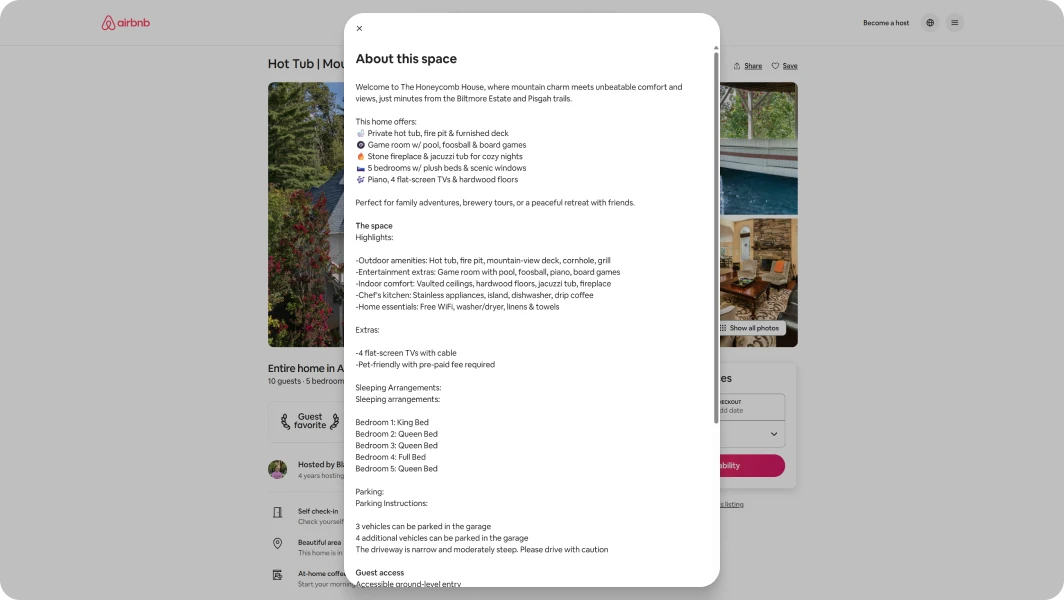
Regardless of platform, every strong listing follows a basic structure. Understanding this framework makes writing easier and more effective.
This is your most important real estate. Guests decide whether to read further based on these opening lines. Don't start with obvious statements like "This is a beautiful house." Instead, immediately communicate your unique value.
Your opening should answer one of these questions:
BEFORE: "Welcome to our cozy mountain retreat! You'll love staying here."
AFTER: "Ski-in access to Jack Frost (200 yards), hot tub on private deck, sleeps 8 in 4 king bedrooms. Perfect for families or groups seeking Pocono winter getaways."
What changed: Specific location details, exact capacity, clear target audience, unique selling points up front.
This is where you get specific. Guests need to know exactly what they're getting. This section should cover:
Bedrooms and Bathrooms: Don't just say "3 bedrooms, 2 bathrooms." Specify bed types: queen, king, double, single, or sofa bed. Specify bathroom features: shower, bathtub, rainfall showerhead. Many travelers have specific sleeping or accessibility needs.
BEFORE: "Three comfortable bedrooms with plenty of space."
AFTER: "Master suite: King bed + ensuite with soaking tub and rainfall shower. Bedroom 2: Queen bed, mountain views. Bedroom 3: Two twin beds (perfect for kids). All rooms include fresh linens, blackout curtains, and ceiling fans."
What changed: Exact bed sizes, specific bathroom features, thoughtful details like blackout curtains, clear family-friendly layout.
Kitchen and Dining: Describe the kitchen in detail. Is it fully equipped with dishwasher, oven, stovetop, and microwave? Include cooking utensils, pots, and pans. Can it handle meal prep for a family? Note the dining table capacity.
BEFORE: "Fully equipped kitchen with everything you need."
AFTER: "Chef's kitchen: 6-burner gas range, double oven, Cuisinart coffee maker, complete spice rack, and granite island seating for 6. Perfect for family breakfasts before hitting the slopes. Dining room table seats 8."
What changed: Specific appliance details, exact seating capacity, use case (family breakfasts), unique features (spice rack, island seating).
Living Spaces: Describe the main living area. Include seating capacity, TV and entertainment system, games, and books. Note the atmosphere: cozy, modern, or luxurious.
Outdoor Spaces: If there's a patio, balcony, garden, or pool, describe it thoroughly. Note furniture, grill access, garden maintenance, and pool size.
Special Amenities: Highlight features that go beyond basic—air conditioning, heating, WiFi quality, washer/dryer, parking. Use our complete amenities checklist to ensure you're not missing anything guests expect.
BEFORE: "WiFi available"
AFTER: "200 Mbps fiber internet—perfect for remote work or streaming. Dedicated workspace with desk and ergonomic chair in master bedroom."
What changed: Specific speed, use cases, bonus workspace detail for digital nomads.
Condition and Style: Briefly describe the overall condition and style—newly renovated, charming vintage, modern minimalist, rustic.
Visitors want to know what's around them. This section should answer:
Critical rule: Don't mention specific competitor properties (no "near Airbnb X" or "better than property Y"). Focus on what makes the area attractive and accessible.
Describe restaurants, cafes, shops, parks, and attractions by type and approximate distance. "3 blocks from excellent Italian restaurants and farmers market," or "10 minutes to city center by car." Be honest about distances and accessibility.
Clear house rules prevent problems and help travelers understand whether the property suits their needs. Setting expectations upfront—then documenting them in detailed guest reviews—protects your property long-term.
End with a warm, welcoming tone. Simple phrases like "We look forward to hosting you!" work well. They remind guests that real people care about their experience.
If your property has age restrictions (common for party prevention or insurance requirements), state them clearly and explain why. Be direct but welcoming.
Direct Approach (Best for party-prone areas):
"Guest age requirement: Primary renter must be 25+. All guests must comply with our no-party policy. Security deposit required."
Friendly Approach (Best for family properties):
"We welcome guests 21 and older, or families with children. This policy helps us maintain a peaceful environment for all neighbors and protects our homeowners insurance coverage."
Pro Tip: Be consistent across all platforms and mention in pre-booking messages to avoid confusion and cancellations.

The difference between mediocre and great descriptions? Specificity. Vague descriptions feel generic. Specific descriptions feel personal and trustworthy.
Words like "beautiful," "cozy," "lovely," and "charming" are meaningless without context. They're subjective and lack concrete detail.
Instead of vague:
Numbers create clarity and help guests visualize the space.
Examples:
Help guests imagine the experience.
Examples:
Each platform has unique features and audience expectations. Tailor your approach accordingly.
Algorithm Optimization:
Airbnb's search algorithm prioritizes:
Formatting Tip:
Use Airbnb's built-in amenities checklist FIRST, then elaborate in your description. Don't just repeat—add context:
Personal Touch:
Airbnb rewards personal stories and local expertise.
Generic: "We hope you enjoy your stay."
Personal: "As a ski instructor at Big Boulder for 10 years, I'm happy to share local trail tips and après-ski restaurant picks. Message me anytime!"
Leverage the Detailed Fields:
VRBO gives you more space—use it. Their audience appreciates thoroughness.
Highlight Family Features:
VRBO's core audience is families and groups. Emphasize:
Use VRBO's "Perfect For" Section:
Be specific about your ideal guest: "Perfect for multi-generational family reunions" or "Ideal for golf buddies' weekend getaway."
Keep It Concise:
Booking.com users often scan quickly. Prioritize:
Emphasize Professionalism:
Booking's audience includes business travelers who value:
Mention Recent Updates:
Booking.com guests respond well to "Recently renovated" or "Newly installed AC system" type language—it signals care and maintenance.

AI can help, but it can't replace your knowledge of your property. Here's how to use it effectively:
Write bullet points of key features yourself:
• 4 bedrooms, sleeps 8
• Hot tub on deck
• 5 min to Jack Frost ski resort
• Game room with pool table
• Chef's kitchen
Ask ChatGPT: "Convert these vacation rental features into a compelling description. Keep it under 150 words, focus on families, mention proximity to ski resorts:"
Edit the AI response for YOUR property's unique details
Add personal touches AI can't know
What AI Can't Do:
Pro Tip: Always run AI-generated text through Grammarly or read it aloud. AI sometimes creates awkward phrasing that sounds unnatural.
Don't exaggerate. If your WiFi is decent but not blazing fast, don't claim "ultra-high-speed internet." Disappointed guests leave bad reviews.
Over 60% of bookings happen on mobile. Your first 2-3 sentences appear in search previews—make them count. Avoid long paragraphs that require scrolling.
What you DON'T mention matters too. If you have stairs and no elevator, mention it for guests with mobility issues. If there's street parking only (no driveway), state it clearly. Surprises lead to cancellations.
While the core information stays the same, tailor your tone and emphasis for each platform. Airbnb wants personality. VRBO wants detail. Booking wants efficiency.
Refresh your copy every 3-6 months. Seasonal changes, new furniture, neighborhood developments—these all deserve mentions. Plus, platforms reward recent activity.

Use this to quickly evaluate and improve any listing:
Week 1: Audit your current listings using the checklist above. Note what's missing or vague.
Week 2: Rewrite following the platform-specific strategies. Use the before/after examples as templates.
Week 3: A/B test on one platform—update your description, track views and bookings for 7 days, compare to previous 7 days.
Week 4: Roll out successful changes to all platforms. Schedule calendar reminder to refresh copy in 3 months.
Bookmark this guide—descriptions should be refreshed seasonally as amenities change and you learn what resonates with guests.
Aim for 500-800 words total across all platforms. Your main property description should be 300-500 words—specific enough to convert without overwhelming mobile readers. Distribute content across separate fields (Property, Neighborhood, House Rules) rather than cramming everything into one section.
The first 2-3 sentences—they appear in search results and mobile previews. Lead with concrete details about what makes your property special and who it's perfect for. Avoid generic phrases like "beautiful home"; instead write "Ski-in access, hot tub on deck, sleeps 8."
Yes—tailor your tone while keeping facts consistent. Airbnb favors personal, conversational language. VRBO's family audience wants detailed amenities. Booking.com users prefer professional, concise copy. Adapt the presentation, not the information.
Yes, but customize heavily. Use AI to expand bullet points and improve flow, then add details only you know: specific house rules, unique views, seasonal tips. AI-generated content without personalization feels generic and reduces bookings.
Every 3-6 months, or when you add amenities or complete renovations. Platforms reward recent activity with better ranking. Even small updates matter—new coffee maker, upgraded WiFi, changed check-in times. Fresh content signals active management.
Airbnb, VRBO, and Booking.com allow hosts to require the primary booking guest be 25+ years old (not all guests). This prevents parties and reduces liability. State your age minimum clearly in house rules, description, and messages across all platforms. Family properties often use 21+; party-prone areas typically require 25+.
Great listing descriptions aren't about flowery language or marketing tricks. They're about clarity, specificity, and honesty. They help the right guests find you and help the wrong guests move on. They set accurate expectations that lead to 5-star experiences.
Your listing copy is working 24/7 to convert browsers into bookers. Invest the time to get it right, and you'll see results in bookings, guest quality, and reviews.
Now go write descriptions that convert. Your future guests are searching right now.



.webp)


.webp)
.webp)
.png)


Guest Experience &
After-Hours Support: