Industry Insights

A quick note: Much of the vacation rental industry commentary defaults to either hype or doom. We've spent the last month cutting through both to answer one simple question: What's actually happening with Vrbo in 2026? This article focuses on verified data, honest context, and what it actually means for hosts. No fear-mongering, no overselling—just facts.
Before we dive in: Vrbo remains the second-strongest platform in the US short-term rental market, holding approximately 29% of the North American market share. If you're managing properties in popular US destinations—beach towns, mountain getaways, family vacation hotspots—these 2026 trends directly impact your bookings and revenue.
Vrbo generated $3.8 billion in 2024, representing a 15.4% increase from the previous year. That's substantial growth, but context matters: 15.4% is slower than the pandemic-era 25-30% growth rates from 2020-2022, which is normal for a maturing platform in a post-COVID market, not a sign of crisis.
Nearly a third of 2024 growth came from multi-unit inventory expansion. This doesn't mean individual hosts are dying. It means the platform is diversifying its supply mix. Professional operators are adding volume alongside individual hosts, not replacing them.
Vrbo grew "in line with the market" in Q1 2025, but growth rebounded to double-digit rates by Q4 2024 and remained solid through the rest of 2025. This seasonal fluctuation is normal for vacation rentals, which peak in summer and dip in early spring.
By late 2025, Vrbo showed strengthening performance in international markets and improved attach rates through the Expedia ecosystem, signaling recovery in the latter half of the year.
The spin you've read: "Vrbo is no longer outpacing Airbnb, golden age is over."
The reality: Both platforms slowed growth as they matured. That's not failure; it's equilibrium in a normalizing market.
Vrbo's gross bookings in 2024-2025 ranged from $17.4B–$22.6B, representing modest 1-9% YoY growth depending on quarter. Yes, growth is slower than the pandemic era. But $20B+ in annual bookings is stable, significant revenue. This is a maturing market, not a declining one.

Starting May 22, 2025, Vrbo modified One Key rewards for lower-tier members:
Meanwhile, on Expedia.com and Hotels.com, all members continue to earn 2% across all tiers.
(Source: Rental Scale-Up, Frequent Miler, Skift)
Expedia stated: "Blue tier members did not drive sufficient repeat bookings to justify the cost."
What this reveals: Vrbo guests are high-value, infrequent travelers. Unlike hotel guests who visit 3-4 times a year, Vrbo guests typically book once every 1-2 years. Loyalty rewards don't influence purchasing behavior for infrequent buyers.
This isn't evil; it's math. Expedia realized cashback wasn't moving the needle for Vrbo, so they redirected those dollars to where they work: hotel loyalty.
The doom narrative: "Vrbo is being dismantled and quietly phased out."
The reality:
Better interpretation: Expedia is optimizing rewards spend, not abandoning Vrbo. They're separating the "frequent hotel traveler" incentive from the "occasional home rental" purchase. That's rational portfolio management, not crisis mode.
.webp)
Major travel industry publications reported on Vrbo's "Readaways" trend in late 2025: travelers seeking quiet, relaxation, and quality time in vacation rentals.
Supporting data:
(Source: Rental Scale-Up, PhocusWire)
What the industry wants you to think: "If your property isn't a reading retreat or farm stay, it's dead."
What's actually happening: Readaways are a growing segment, not a replacement for existing vacation rental categories. Families still want pools, couples still want beachfront, groups still want game rooms.
The real lesson: Diversification is good. Having a reading nook or quiet area helps. But a 3-bed beach condo in Florida doesn't need to become a "reading retreat" to stay competitive. It's just one option in a growing menu.
What's real:
What this means: Experiential travel is absolutely growing. People want stories and unique stays, not just "another beach house."
These trends are real and growing, but they're additions to the market, not replacements. A standard 3-bedroom home in a popular beach town will still book. A barn stay in wine country will also book. Both markets are growing.
For hosts: These trends mean opportunity exists for differentiation. But if your property is a straightforward, well-maintained family home, you're not obsolete—you're in the core market that still represents 60%+ of Vrbo bookings.

What's real:
Important context: These figures represent 50th-percentile earners with well-optimized listings. Average host earnings across all properties are typically lower (~$26k–$50k annually) depending on property type, location, and management quality. The range above reflects properties with solid reviews, strategic pricing, and consistent bookings—not typical beginner listings.
These averages are particularly realistic in strong US markets: Florida Panhandle, Smoky Mountains (Tennessee/North Carolina), Arizona desert destinations, Lake Tahoe, and Outer Banks—where families and groups book months ahead and pay premium rates for whole-home experiences.
What this means: Size matters, and so does optimization. Larger properties command premium pricing, especially for family groups. But execution (photos, pricing, reviews) determines whether you hit these numbers or fall short.
1-2 bedroom properties: Seeing highest booking volume (more guests, shorter stays, more churn)
3+ bedroom properties: Seeing highest revenue per booking (families planning months ahead, 4+ day stays, $2000-4000+ total revenue per booking)
Best strategy depends on your property type. A 1-bed shouldn't compare itself to a 3-bed—they're different markets.
Average lead time remains 47 days (81% longer than Airbnb). This is actually good for hosts—predictable income, ability to plan maintenance, fewer spontaneous last-minute changes.
This advantage hasn't changed and remains a core Vrbo differentiator.
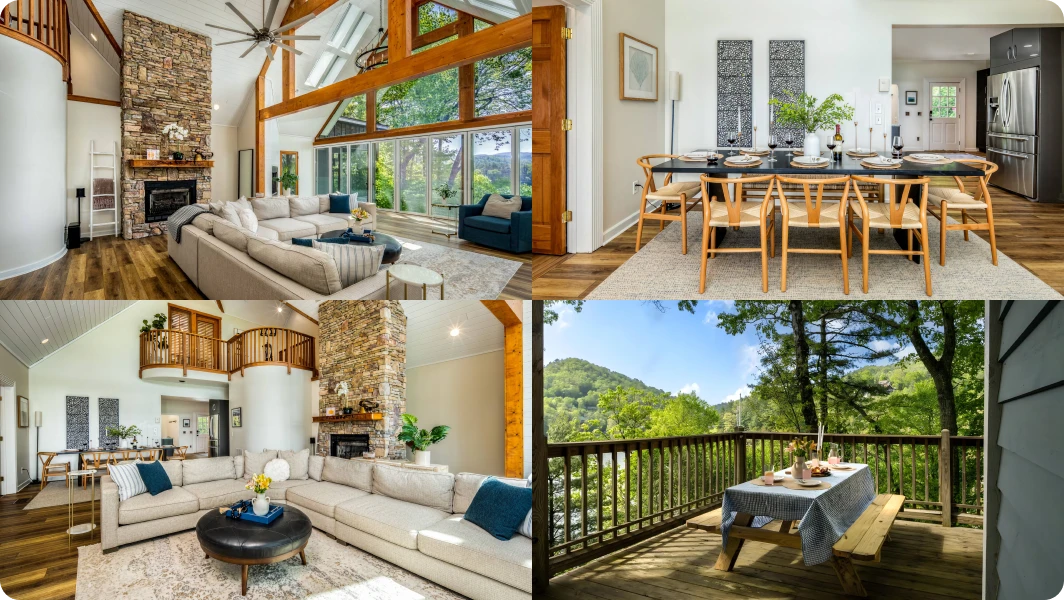
Barn bookings surged 55%, houseboats by 40%, and treehouses by 30% on Vrbo compared to the previous year, showcasing a strong move toward unique, experiential stays.
This trend is especially strong in states like Tennessee, North Carolina, Vermont, and Colorado, where rural retreats and farm stays are seeing double-digit booking growth. Meanwhile, classic beachfront and lakehouse properties in Florida, Alabama, and Texas continue to drive the highest overall volume.
But here's the context: While unique stays grow fastest in percentage terms, the majority of Vrbo bookings still come from standard family homes, beachfront condos, and mountain cabins. These core property types continue to represent the bulk of Vrbo's portfolio and book consistently with solid reviews and good pricing.
For new hosts especially: Getting visibility in those first 30-60 days matters. Strategic promotions can help you overcome the cold-start effect and build initial reviews faster.
For all hosts: Adding differentiation (e.g., a quiet reading nook, local experience recommendations, or unique aesthetic) can improve visibility in a competitive market. But a well-maintained 3-bed beach home doesn't need to become a "themed experience" to remain competitive. Good photos, honest descriptions, and reliable service still win—in fact, capturing quality photos is often where most hosts fall short.
With Independence Day falling on a Friday for the first time since 2014—a rare alignment that won't happen again until 2031—Vrbo reports the week leading up to July Fourth will be the busiest of the year. But this is one-off demand.
Labor Day weekend offers great value and less competition compared to Memorial Day or July 4. If you're a guest, book then. If you're a host, this presents an off-peak opportunity with less discounting pressure.
October is the sweet spot for both guests and hosts—some of the year's lowest rates and perfect fall weather, which means flexibility for hosts to price aggressively without sacrificing bookings.
Vrbo's 2025 Vacation Rentals of the Year showcased homes ranging from three to nine bedrooms, with nightly average rates between $400 and $4,000, in the most in-demand destinations, including the Florida Panhandle, Scottsdale, Arizona and Gatlinburg, Tennessee.
Notice what's missing? Regular people's homes. The selected homes reflect nearly 300 10/10 guest ratings, experienced and dedicated hosts, and stunning spaces with private pools and fully equipped entertainment rooms.
The narrative is still "family vacations," but the actual showcase is premium, high-end properties. However, this is marketing—premium homes get featured. Thousands of standard listings still book consistently with good management.
In 2025, the U.S. vacation rental market was projected to generate $20.08 billion in revenue, growing at a CAGR of 4.13% through 2029, reaching $24.78 billion, with approximately 62.57 million users. Steady growth, but not explosive.
Key guest segments include families (40% of bookings) prioritizing kitchens (64%) and pet-friendly options (31%), and Millennials/Gen Z (30.9% of the market) favoring unique stays like barns (55% growth) and urban rentals.
AI-powered tools and smart automation are driving profitability, with dynamic pricing systems increasing RevPAR by +10.7%. The difference between hosts using dynamic pricing and those with manual pricing is significant.
To see this in practice, our case study shows how one Airbnb went from a new listing to a $150K performer in one year using strategic pricing. The lesson: pricing strategy matters more than most hosts realize. If you're manually adjusting rates, you're likely leaving 10%+ revenue on the table.
Unlike Airbnb's mixed approach (shared rooms, private rooms, entire homes), Vrbo remains exclusively whole-home rentals. That positioning is still valuable—just not as differentiated as it once was.
Predictable advance bookings are valuable for cash flow planning. But predictability cuts both ways: less spontaneity means less flexibility for pricing.
"Family" now means something different in 2026. It's book clubs, farm retreats, and reading escapes—not just Disney vacations and ski trips. But families remain the primary target audience.

The accurate picture:
What's changing:
Single-property hosts face real headwinds, but not because "Vrbo is dying":
Based on verified trends, not fear:
Vrbo in 2026 is a mature, stable platform, not a declining or dying one. It's part of a $50B+ empire with significant competitive advantages:
For guests: Still the best option for privacy and space
For hosts: Still viable, but requires proper optimization and realism about competition
The "doom & gloom" narrative you see everywhere? It's often coming from people exaggerating market challenges. Don't fall for it.
The real challenge is just... being competitive in a mature market. That's it.
If you're managing a Vrbo property and want to explore optimization strategies, we share case studies and detailed guides on our blog about pricing, listings, and multi-channel management. But first—make sure you're working with the facts, not the fear.




.webp)
.webp)
.png)




Guest Experience &
After-Hours Support: