Industry Insights
How to Airbnb Your House: A Step-by-Step Guide to Starting a Short-Term Rental Business


Updated on:
November 12, 2026


You own a home, a cabin, a condo, or a free space, and you're thinking about turning it into a vacation rental on Airbnb. The idea is simple: guests come to your place and pay for each night they stay. The reality is a little more complicated.
Starting a vacation rental business is less about the property itself and more about the order in which you do things. Get the basics right first, and everything after that gets easier.
This guide is written for owners in the USA who already have a property and want to Airbnb their house. It walks through everything in the order we'd tackle it, then covers what to do after launch.
The rest of this guide covers each of these in detail.
A vacation rental business means renting out a property to guests for short stays, usually a few nights up to a few weeks.
In US government terms, this is called a short-term rental. The Congressional Research Service at the Library of Congress describes it this way:
Short-term rentals (STR) do not have an official definition but are generally furnished homes or rooms rented for fewer than 30 days, often for tourism or short-term business travel. — Congressional Research Service, Short-Term Rental Markets: A Primer, Library of Congress
In practice, the rules come from states, counties, and cities, so the exact cutoff and requirements depend on where you are.
Guests come and go, income changes with the season, and every stay needs cleaning, communication, and care.
That's why it's better to think of it as hospitality, not passive income: marketing, bookings, cleaning, maintenance, and guest support are all part of the job.
It's worth knowing the difficult parts of owning a vacation rental upfront, so nothing comes as a surprise.
None of this means you shouldn't start. It means planning ahead, which is what the steps below are for.

Before you spend a dollar, find out whether you can rent your place and whether you're covered. Go through these in order: the first three can tell you to stop.
Almost any home or space can work. There are guests for a city apartment, a countryside cabin, and a spare room, and they all have different budgets and preferences. You can list an entire place or just a room, and Airbnb has around 30 property types, from houses and apartments to farms, tiny homes, and yurts. You also don't need a separate property: some owners rent out their own home while they're away or a spare room while they're in town.
What matters is a comfortable space and clear expectations. Before you go on, ask yourself:
Location matters too. City rentals tend to book steadily, but they face more competition and stricter rules. Mountain, lake, and beach rentals follow the seasons, so plan for quiet months. In a village or rural area, internet and local help come first.
In the US, there is no single set of rules. States, counties, and cities write their own, and they differ a lot. Some places ask for a permit or registration for short-term rentals, some limit how many nights you can rent, and nearly every place charges a lodging tax. New York City, for example, bans renting an entire home for under 30 days. Your HOA or building can ban short-term rentals too, and your mortgage or lease may have its own rules.
Ask your city or county office:
Don't rely on Airbnb to keep you compliant. Its tools help, but the responsibility is yours.
A regular homeowner's policy often isn't written with paying guests in mind. Find out before you list, not after.
Ask your insurer:
Pro tip: Ask for the answers in writing. It matters if you ever have to make a claim.
Airbnb includes AirCover for Hosts with every booking: up to $3 million in damage protection and $1 million in liability insurance. It has limits, so it doesn't replace your own policy.
Once the rules and insurance check out, sign up at airbnb.com/host/homes and click to become a host. Airbnb asks you to verify your identity and add your payout details. You can set up your listing step by step and prepare your space at your own pace.
Nightly rate times nights booked is not your income. The platform fee comes off first, then the everyday costs:
Set aside a cash reserve too. Slow months and surprise repairs are normal, and a reserve keeps one bad month from becoming a crisis. Airbnb usually pays out about 24 hours after a guest's scheduled arrival, so plan your cash flow around that.
Add it all up before you commit. Whether the rental is profitable depends on your location, your costs, and your pricing.

A home that's comfortable for you isn't automatically ready for guests. Missing basics turn into complaints, and complaints turn into reviews.
Not everything matters equally. Start with the three things guests can’t do without, then add the extras that make the stay memorable.
The three things that have to work:
Nice extras:
The amenities guests search for most on Airbnb are wifi, a washer, free parking, a kitchen, and air conditioning, according to Airbnb's 2025 data. You don't need all of them, but list the ones you have.
Stock fresh linens, towels, toilet paper, soap, and shampoo, and use an amenities checklist so nothing is missing. Lock your valuables in a closet or take them off-site.
Pro tip: Sleep there for one night first. Treat it like a guest would, then fix what bothers you. It doesn't have to be perfect on day one. A clean space, a decent mattress, and stocked coffee matter more than new furniture.
Guests should know what to expect before they book. So should you. Get these in writing before you list, including house rules that protect your property:
Decide your cancellation policy now, while you're calm, and stick to it. New hosts often get asked to bend the rules.
Put the rules in your listing and repeat them in your pre-arrival message.
Airbnb walks you through it, and it takes about an hour if your photos and description are ready.
After you publish, it can take a day or two before your listing starts showing up in search. Airbnb's getting started guide walks through each screen.
After the photos, your title and description are what convince a guest to book. The title earns the click, and the description answers the questions a guest has before booking: what the place is like, who it suits, and what’s around it. Write both for the guest you want to host.
Airbnb is the most popular place to start, but Vrbo and Booking.com reach different guests, and it helps to know how guests choose between platforms. Each platform also charges differently, as the table shows.
Start with Airbnb. If you add more platforms later, sync your calendars so you never get a double booking. And before you add one, it's important to know what each platform charges: the fee decides whether the extra bookings are actually worth it.
Cleanliness is one of the most important factors in guest reviews, according to Airbnb. Your cleaner sees the property after every stay, so they're your first line of quality control.
Pay fairly and treat them well, because a good cleaner is hard to replace. Here's how to find a good cleaning service.
Communication starts the moment someone books and runs until they check out. Quick, clear messages lead to better reviews.
Guests skim, so keep messages short, don't bury the important details, and tell them to contact you if they need anything.
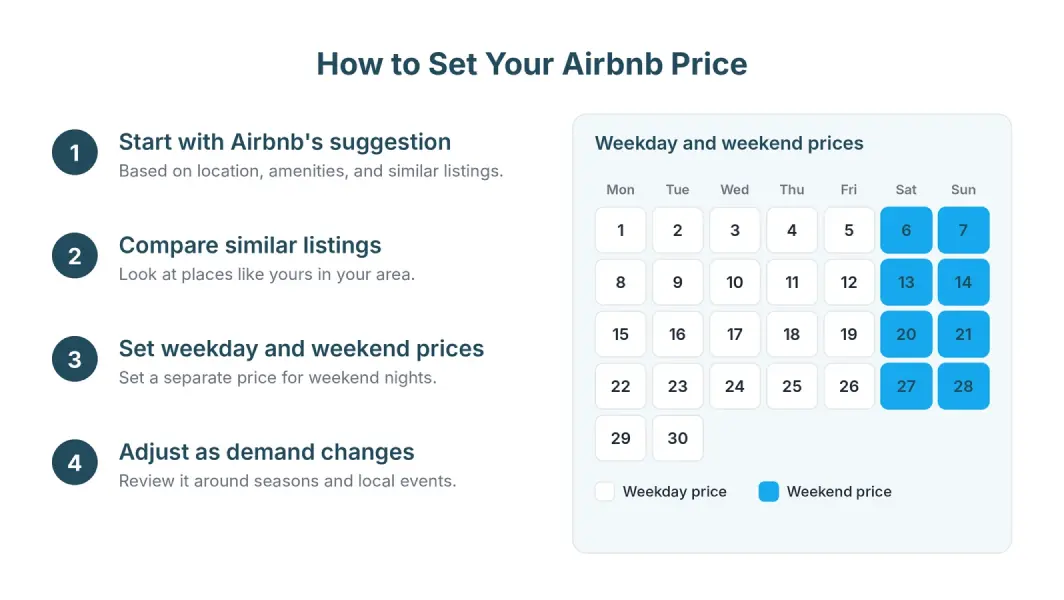
Price is one of the first things guests compare. In search, your listing sits next to similar ones, and a price that's too high sends guests straight to the next option. Too low, and you leave money on the table or make guests wonder what's wrong. Staying competitive means knowing your market and adjusting as it changes.
Airbnb shows a suggested price based on your location, amenities, and similar listings nearby. Use it as a starting point, set separate weekday and weekend prices, and compare your listing to similar ones in your area. You can change your price any time.
Two terms are worth knowing: average daily rate (ADR) is your average income per booked night, and occupancy rate is the share of available nights that get booked. Low occupancy can mean your price is too high, and almost always being booked can mean it's too low.
For most new hosts, Airbnb's suggested price and a regular look at similar listings are enough. Dynamic pricing, software that adjusts your price automatically as demand changes, is what more serious hosts and owners with several properties tend to use. If you get there, here's how dynamic pricing tools compare.
Airbnb offers several types of promotions and discounts:
A discount lowers your income per night, so use it for a reason: filling a slow period, getting your first reviews, or encouraging longer stays.
A direct-booking website avoids platform commission and brings guests back, so many owners add one later. Google Vacation Rentals works through approved channel managers, not direct listing. Instagram and Facebook suit a rental well, and a list of past guests is your easiest source of repeat bookings.
Pro tip: New hosts are often contacted by people who want to move the conversation or payment off the platform. Don't. Keep bookings and payments on Airbnb.
Your listing is live, and the first guests are on their way. What you do now shapes your reputation: you need those first reviews, and you need to decide who runs the rental day to day.
A new listing has no reviews, and guests hesitate to book a place nobody has stayed in yet. Both Airbnb and Vrbo need three reviews before your overall rating shows, so your first reviews matter a lot. Decide your starting price, whether to use the new listing promotion, and how you'll make sure the first guests have an excellent stay.
You can self-manage, bring in a co-host (Airbnb has a Co-Host Network of local hosts), or hire a full-service manager. Each has a different cost and level of involvement, so it's worth comparing them before you decide.
Read and reply to every review, and fix anything several guests mention. Keep up with maintenance, adjust your price as the seasons change, and recheck your local rules from time to time, since they change.
Here's what we see most often: owners set up the listing once and forget about it. They don't add new photos, and they don't update the description when something changes. Treat your listing as a living page. Add photos when you upgrade the space, and refresh the description when you add an amenity or change something in the house.
Work it out for your own house. Add up your yearly costs, look at what similar listings in your area charge, and compare. If the numbers only work when you're booked almost every night, that's a warning sign. And check the rules first, because some places don't allow it at all.
Your own number comes from a short walkthrough. Go through the house as a guest and write down what's missing, such as linens, kitchen basics, or a smart lock. Then add your city's permit or registration fee, insurance, photos, and a cash reserve for slow months. The total is what you need. The costs section above lists everything to plan for.
Read your mortgage terms and ask your lender whether renting to guests is allowed. Get the answer in writing.
In many places, yes. Call your city or county office and ask the questions listed in the rules section above before you list.
Yes. Airbnb lets you list an entire place or just a room. Ask your local office whether your area has different rules for rooms.
Airbnb charges most hosts a fee of 15.5% of each booking. Vrbo charges a 12% commission since October 29, 2026, and Booking.com is usually around 15%. Check your own account, because fees can differ by host and market.
Airbnb includes AirCover for Hosts with every booking, with up to $3 million in damage protection and $1 million in liability insurance. It has limits, so ask your own insurer whether your policy covers renting to guests, and get the answer in writing.
The listing itself takes about an hour if your photos and description are ready. Checking your local rules, sorting out insurance, and getting the house guest-ready usually take longer, so start with those.
Start with good photos, a clear title and description, and a competitive price. A new listing can also use Airbnb’s new listing promotion, which gives 20% off your first 3 bookings. Those first guests matter, because both Airbnb and Vrbo need three reviews before your rating shows.
No. Self check-in, a reliable cleaner, and a trusted handyman can cover most of what needs doing in person. You can also bring in a co-host or hire a full-service manager. You’ll still need to answer guest messages quickly, wherever you are.
If you're asking how to start a vacation rental business, how to start a short-term rental business, or how to Airbnb your house, the order is simple: rules and insurance first, then the property, then the listing, then pricing and guests.
Triad Vacation Rentals manages vacation rentals for owners, handling the listing, pricing, guest messages, and cleaning coordination.
Thinking about starting a short-term rental business? Book a call with Triad and we'll talk through your property and what getting started would look like.










Guest Experience &
After-Hours Support:


