Case Studies
How We Turned an Off-Season Lake Granbury Launch Into an Airbnb Guest Favorite in 4 Months


Updated on:
June 17, 2026


Most vacation rental owners avoid launching new properties during the off-season. Fewer travelers, lower demand, and tough competition. It's the worst time to start.
Logan and Erin Verrett didn't have a choice—or maybe they just trusted the process.
They launched their lake house on August 15, 2025, during one of the slowest months for Texas lake rentals. For 30 days, the calendar was empty. No bookings, no reviews, nothing.
Four months later, the property earned Airbnb's Guest Favorite badge and generated $11,245 in revenue across 16 bookings—including a weekend rate increase from $160 to $250.
The lesson? Off-season isn't a disadvantage if you have the right strategy. It's an opportunity to build while the competition sleeps.
Three things make a new listing hard to launch: it's brand new, it's off-season, and it has no reviews.
Logan and Erin's property had all three working against it.
The listing itself was exceptional—professional photos, compelling copy, and proper setup. But being new means zero algorithmic credibility. Being August means fewer people searching for lake rentals. And having zero reviews means Airbnb's search algorithm essentially ignores you in favor of established properties.
Without reviews, you don't rank. Without ranking, you don't get bookings. Without bookings, you never get reviews.
That's the cold-start effect for new listings. The calendar was empty not because the property wasn't great, but because it was new, the season was slow, and there was nothing to convince the algorithm—or potential guests—that this was worth booking.
For 30 days, nothing happened.
Turning a new listing around takes three things working in perfect sync: smart pricing strategy, owner cooperation, and tactical differentiation.
Here's what most new landlords miss: pricing isn't something you set once every few weeks. During the launch phase, pricing is a daily lever.
We manually adjusted rates daily—not just for the next few weeks, but months in advance. Here's how it worked:
Week 1-4 (August): We launched the weekend rate at $160, intentionally undercutting nearby competitors by 10-20%. The goal wasn't to maximize revenue; it was to get that first booking and jumpstart reviews. We tracked every competing listing on Airbnb's dashboard and local comps constantly.
Month 2-4 (September-December): As reviews accumulated and the Airbnb Guest Favorite badge appeared, we raised rates. By December, the same weekend was commanding $250—a 56% increase from launch.
The formula is simple but requires discipline: Lower rates drive bookings. Bookings drive reviews. Reviews drive visibility. And visibility drives higher rates later. We weren't trying to hit the target margin in month one. We were building momentum for month four and beyond.
New listings only work if the owners are truly invested. Logan and Erin weren't passive observers—they were active partners throughout.
Here's what they did:
Most importantly, they understood that new listings need time to build momentum organically. Many owners would have given up or made desperate moves; Logan and Erin stayed committed to the strategy.
We didn't just optimize the listing. We made the property more valuable than the competition—before guests even booked.
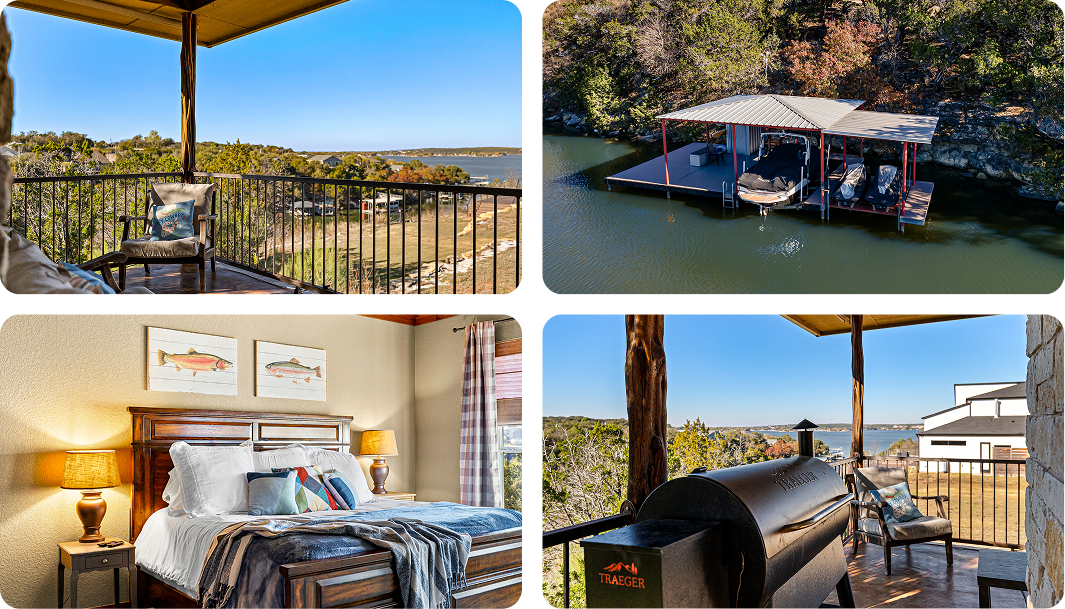
We secured a partnership with Sam's Dock Boat Rentals, one of Lake Granbury's premier watercraft rental companies. Now every guest receives:
That's not just an amenity listed in the description. That's a concrete reason to book this property over the dozen identical lakefront rentals nearby.
Guests come to a lake house to experience the lake. By embedding partnership discounts directly into the booking, we removed friction and added genuine value. Instead of guests scrambling to find and book boat rentals after arrival, the discount is waiting in their confirmation email.
Honest note: Off-season impact was limited—fewer guests meant fewer boat bookings. But this partnership positions the property perfectly for spring and summer, when lake activity peaks and the discount becomes a major differentiator.
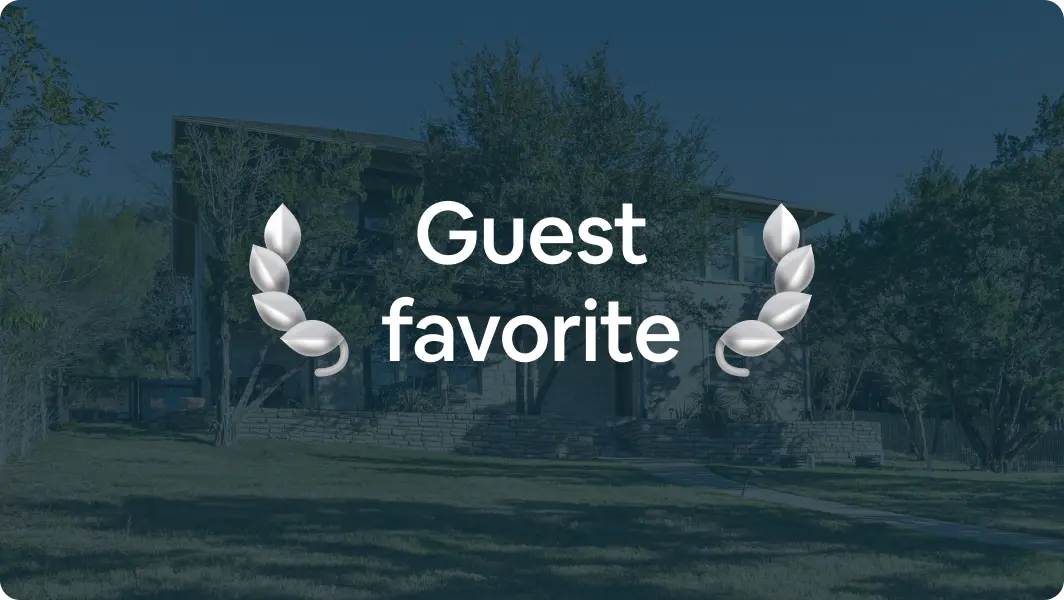
The turnaround wasn't instant, but it was inevitable once the strategy took hold.
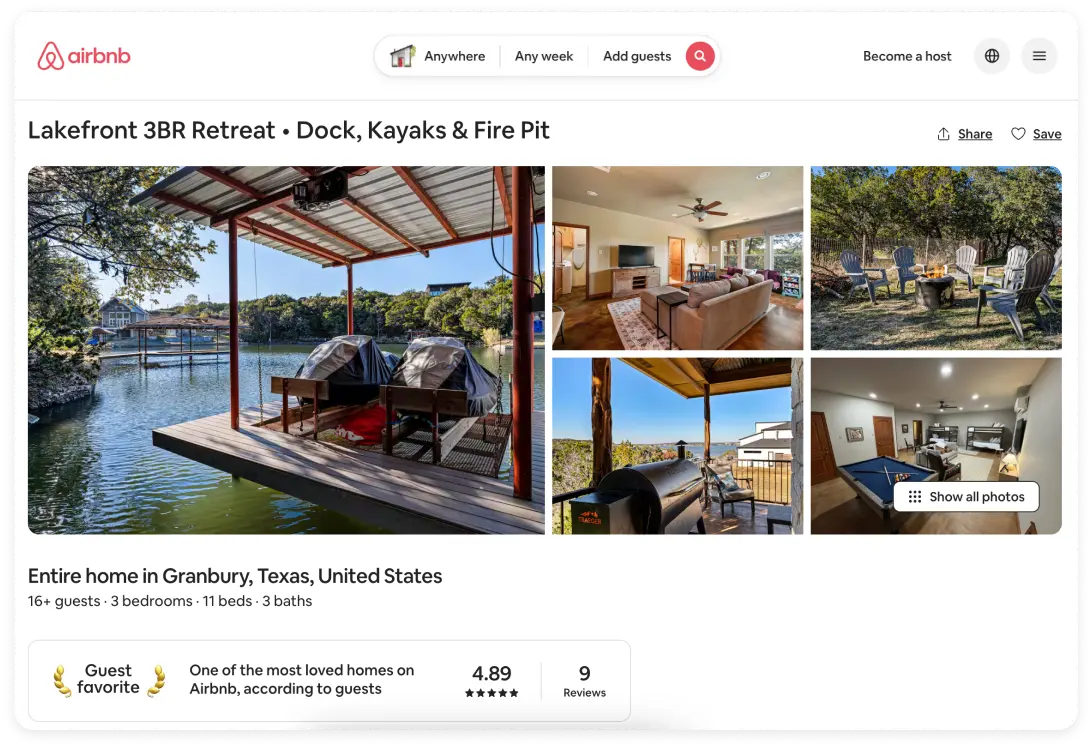
That single badge changed everything. It tells Airbnb's algorithm to promote the listing, and it tells potential guests this property has real social proof.
In 4 months, Logan and Erin generated $11,245 in host payout (after Airbnb fees) across 16 bookings with an average occupancy rate of 46%.
The property that started with zero visibility, zero reviews, and zero bookings now has algorithmic backing, 5-star reviews, and momentum heading into peak season (April-September, when Lake Granbury demand peaks and rates typically hit $300+).
New listings need visibility-first pricing. You're not trying to hit your target rate in month one. You're building reviews and algorithmic credibility. We started at $160 and climbed to $250; that progression is normal.
Pricing should be treated as a daily decision during the launch phase, not set-and-forget. Markets shift. Competitors adjust. Your rates should reflect what's happening in real time.
Triad can optimize and strategize, but the property owner has to be invested. Implementing recommendations, making strategic investments in the listing, and staying patient during slow periods—these actions don't scale if the owner doesn't care. Logan's and Erin's patience and participation made the difference.
On a lake with dozens of lakefront rentals, the one with embedded boat rental discounts has a structural advantage. Partnerships turn commodities into distinct choices.
August had zero bookings. That empty calendar felt discouraging, but it was the groundwork. By month four, that investment paid off with reviews, badges, and momentum.
Off-season isn't ideal, but it's not fatal. The tradeoff: fewer guests means slower initial momentum, but it also means less competition and more time to refine before peak season. Lake markets especially vary by season—summer bookings spike, winter drops. Build during the slow season, and you're positioned for the busy one.
Logan and Erin's property has already proven it can earn Guest Favorite status in the off-season—a badge that typically requires a 4.9+ rating, zero cancellations, and consistent guest love. That's no small feat for a 4-month-old listing.
Now comes the real test: peak season.
Lake Granbury's busy season runs from April through September, when demand spikes and rates for comparable lakefront homes hit $300-400/night. With the foundation already built—reviews, algorithmic promotion, and a partnership with boat rentals—this property is positioned to capture that peak demand.
Our projection: 70%+ occupancy during peak season (April-September), with rates likely staying above $300 on weekends. That's based on market comps and the trajectory we're already seeing. But it depends on continued optimization and the owners' commitment to maintaining the quality that earned Guest Favorite.
The slow August launch? It wasn't a weakness. It was the perfect time to build, test, and refine before the real money months arrived.
If you're launching a new rental, expect the first month to be quiet. That's not failure. That's stage one.
What matters is what you do during that silence. Do you optimize relentlessly? Do you make strategic partnerships? Do you keep the owners aligned and patient? Do you have a system that adjusts daily instead of weekly?
Logan and Erin Verrett did all of that. They trusted the process, stayed disciplined with pricing adjustments, and invested in the small optimizations that compound. Four months later, they earned Guest Favorite status on one of Texas's most competitive lake markets.
More importantly, they're positioned for peak season. When April arrives and lake demand spikes, they won't be scrambling to build reviews or debug their listing. They'll be ready to capture premium rates from a foundation already proven.
If you're planning an off-season launch and want to do it right—with daily optimization, strategic partnerships, and an owner-focused strategy—let's talk.
Book a free strategy session with Triad Vacation Rentals



Guest Experience &
After-Hours Support: